
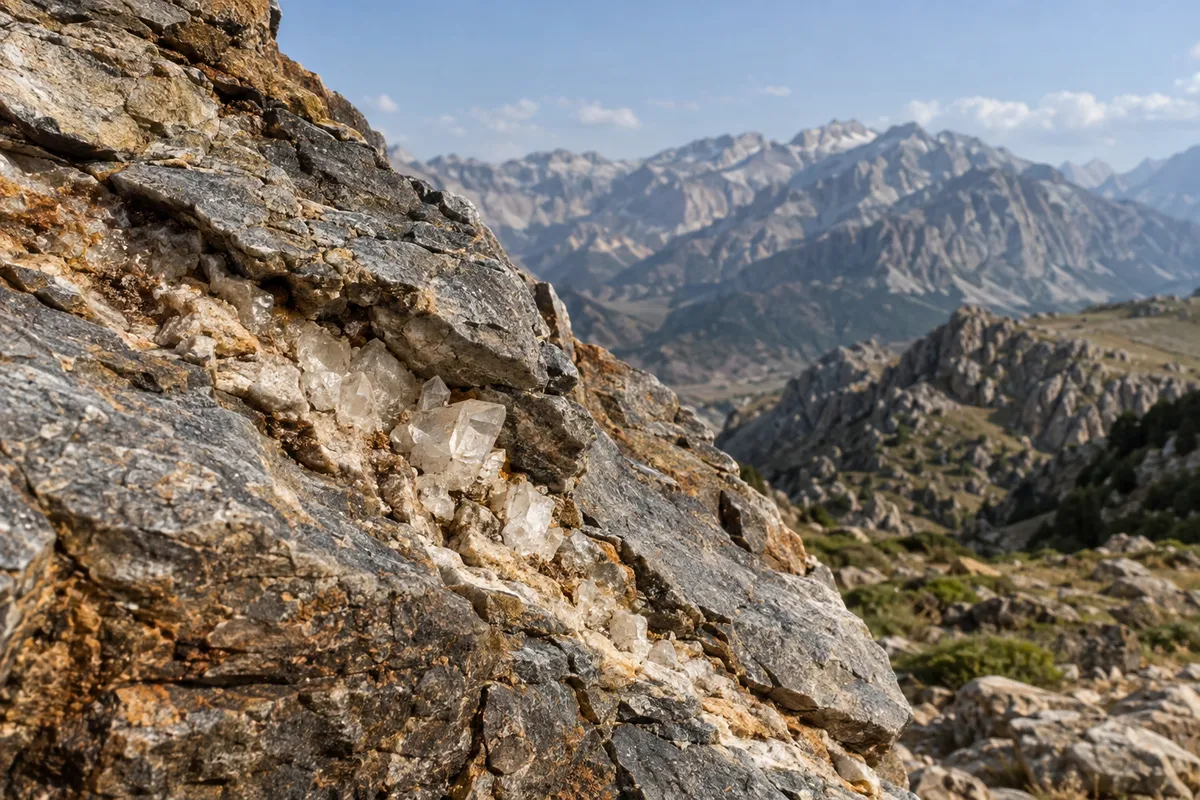
Mountains look permanent, but their histories are anything but simple. Researchers studying Türkiye's Central Taurides have now found a chapter that earlier timelines missed, and they found it in tiny calcite crystals that grew inside active faults. By the end of this article, you'll understand how scientists read a mountain range's past from a mineral, and what this one revealed.
Per a report from Phys, the team used U–Pb dating of fault-formed calcite to rewrite the tectonic timeline of the Central Taurides. Their result: a previously overlooked phase of sideways crustal movement sits between an earlier period of compression and a later, long-term period of stretching.
The new timeline in three moves
The revised story runs like this, according to the Phys report:
- Compression. The crust is squeezed, the kind of pressure associated with plate collisions that build mountains.
- Sideways movement. A phase earlier work had missed, in which the crust slid laterally.
- Extension. Long-term stretching, which the study places as beginning around 25 million years ago.
The key point is the middle step. Without it, the record jumps from squeezing to stretching, as if nothing happened in between. The calcite helped fill that gap.
Why a crystal can date a fault
Faults aren't just cracks. When rock moves along them, fluids can flow through, and minerals such as calcite can crystallize inside. Those crystals are effectively stamped with the moment of fault activity.
U–Pb dating works as a geological clock. Uranium decays into lead at a known rate, so measuring the ratio of the two in a mineral gives an age. Applied to calcite formed in active faults, it dates when the fault was moving, not just when the surrounding rock was created. That distinction matters: the surrounding rock may be far older than the movement you want to understand.
The summary of the study doesn't give the specific ages of each calcite sample beyond the roughly 25-million-year start of stretching, so we'll stay with what's reported.
Why mountains keep these records
Mountain ranges preserve the scars of past plate collisions. Each phase of squeezing, sliding or stretching leaves faults behind, and those faults can hold datable minerals. Reading them in order is a bit like reconstructing a story from diary entries written at different times, each one in its own handwriting.
The challenge has always been getting reliable dates for the entries. Fault-grown calcite offers a direct way to do that, which is why a method that sounds narrow can reshape a regional timeline.
What it means for the bigger picture
Per Phys, the findings refine how scientists understand mountain-building, plate collisions and the evolution of the Eastern Mediterranean. A better-dated sequence in the Central Taurides gives researchers a firmer anchor for models of how the wider region deformed over time.
That's a reasonable reading of why the work matters, though the details of how it changes regional models would need the full paper.
How to picture it yourself
If you want the idea to stick, try this mental image. Imagine pressing both hands together on a sheet of clay: it buckles upward. That's compression. Now slide one hand forward while the other holds still: the clay shears sideways. Finally, pull your hands apart: it thins and stretches. The Central Taurides, per this research, went through all three, in that order, and the middle one had been easy to overlook.
The takeaway
When you look at any mountain range, remember that its shape is the final frame of a long film. Tiny crystals in its faults can tell you what happened in the scenes you didn't see, and in Türkiye's case, one of those scenes had been missing until now.