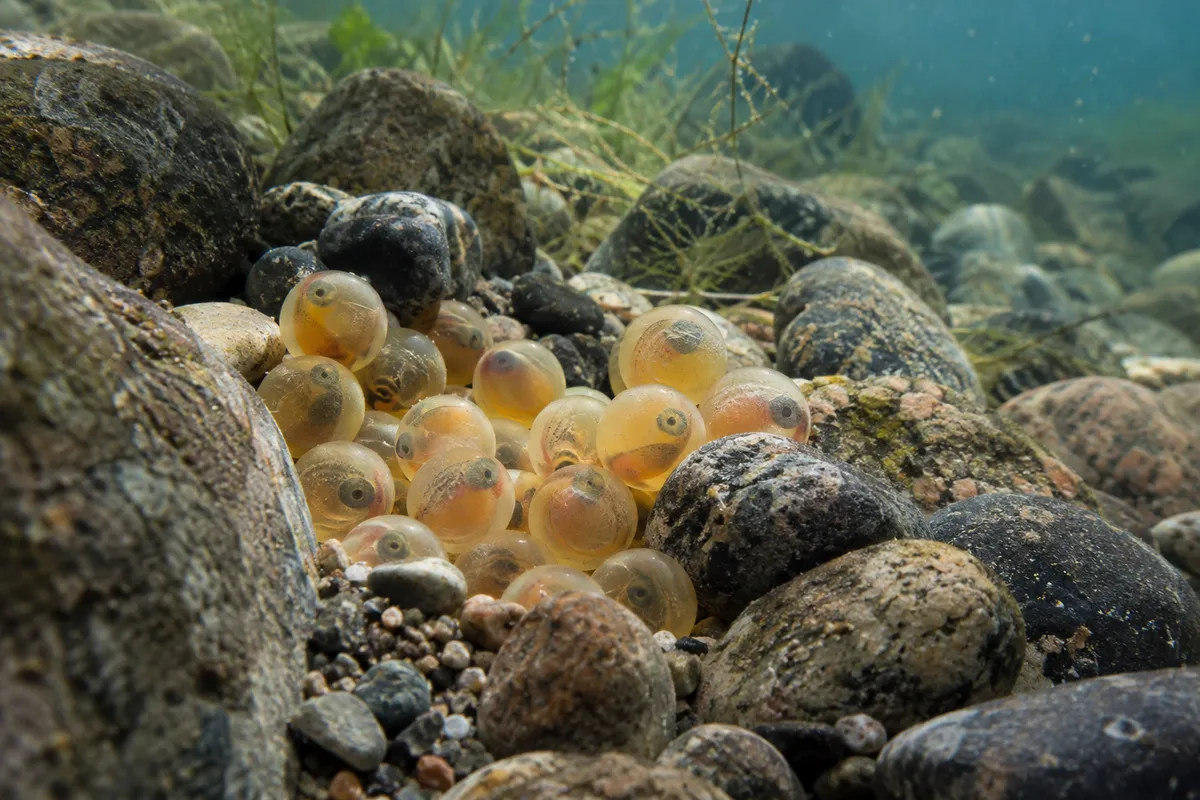
If you want to understand why good lab science can still lead conservation astray, a tiny lake trout embryo makes a useful case study. By the end of this piece, you'll know what researchers found about vitamin B1 in wild trout eggs, why it complicates a decades-old assumption, and what it does and doesn't tell us about restoring fish in the Great Lakes.
What the new study found
Per a report from Phys, a new study found that lake trout embryos developing naturally in Lake Champlain accumulate significant amounts of thiamine, also known as vitamin B1, from their environment. That runs against decades of hatchery-based research, which pointed to thiamine deficiency as a major threat to fish survival.
The suggestion is that wild embryos may naturally pick up enough B1 to offset the deficiency problems that affect hatchery-reared populations.
That is a notable shift. The embryos aren't only relying on what they start with. According to the report, they take up thiamine from their surroundings as they develop.
Why thiamine deficiency has worried fisheries managers
The problem has a name: thiamine deficiency complex, or TDC. Per the Phys report, it has long been treated as a critical barrier to restoring wild lake trout populations. Fisheries managers across the Great Lakes have struggled for decades to bring those populations back, and TDC has been assumed to be part of the reason.
Lake trout matter both ecologically and economically, so the stakes of getting the diagnosis right are high. If you're steering restoration money and effort, you want to aim at the real bottleneck.
The lab-versus-wild gap
Here is the lesson that carries beyond fish. Much of what scientists understood about thiamine and lake trout came from hatcheries. Hatcheries are controlled environments, which makes them excellent for isolating a variable. They are also, by design, not the lake.
The new findings suggest that something present in the natural setting, a source of thiamine the embryos can absorb, may be missing from the picture that hatchery studies painted. When you raise embryos in a controlled setup, you learn how they behave in that setup. Whether it matches what happens in open water is a separate question, and this study is an example of asking it directly.
A fair reading is that the hatchery research wasn't necessarily wrong about hatchery fish. The open question is how far its conclusions stretch to wild ones.
What this could change
Per Phys, the research challenges the assumption that TDC is a critical barrier to recovery, and it could reshape conservation strategies and restoration priorities. If wild embryos can top up their own B1, then effort aimed at thiamine deficiency might be less decisive for wild recovery than assumed, and managers might look harder at other obstacles.
A few cautions are worth keeping in mind, and they are my own read rather than claims from the study:
- One lake is one lake. Lake Champlain's results don't automatically describe every Great Lakes population.
- Finding that embryos accumulate thiamine is not the same as proving deficiency never harms wild fish.
- Changing management priorities usually takes confirming evidence from more than one study.
So treat this as a strong reason to re-examine an assumption, not a final verdict.
How to read conservation news like this
You can apply the same skepticism to other headlines about saving a species. Three questions help:
- Where was the evidence gathered? A controlled facility, or the animal's natural habitat?
- What was left out? Controlled setups remove variables on purpose. Some of them may matter in nature.
- Has it been checked elsewhere? A finding gains weight when it holds in more than one place.
In this case, asking question one is exactly what shifted the conversation.
The takeaway
When a conservation claim rests on controlled-setting research, look for the follow-up that tests it in the wild. For lake trout, that follow-up in Lake Champlain just made a long-standing assumption a lot less certain.