
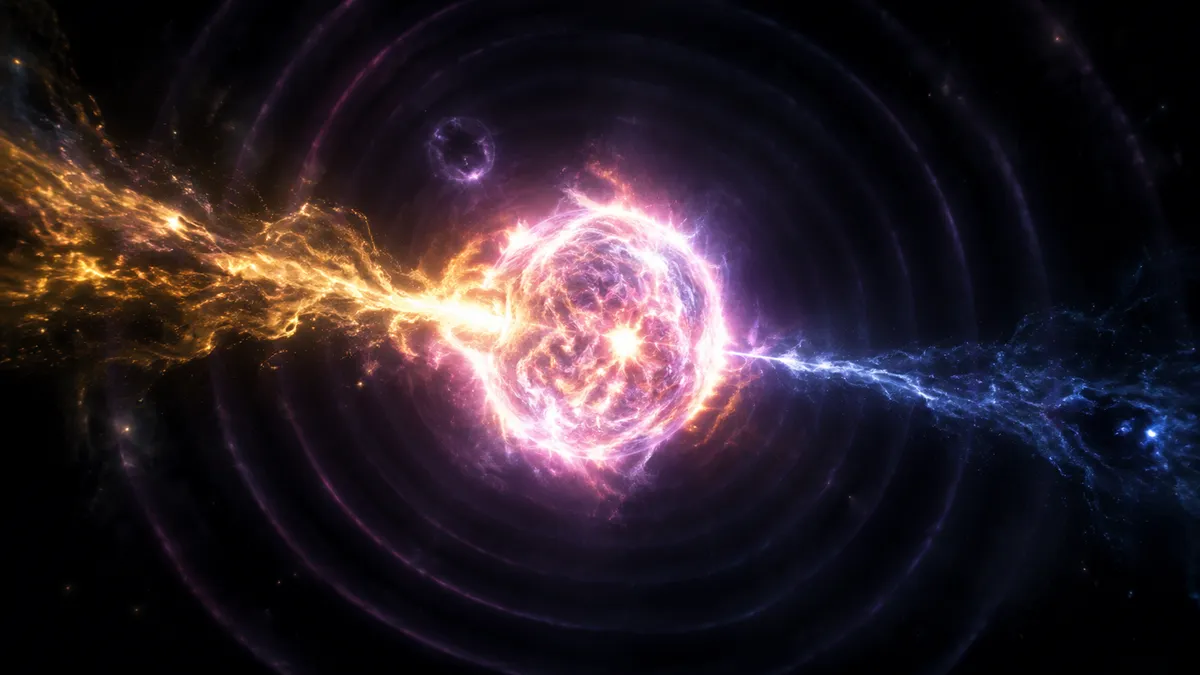
Here is a puzzle that should bother you a little: by every simple rule physicists know, the Big Bang should have produced matter and antimatter in equal amounts, and they should have wiped each other out. Instead, something was left over. That something is every star, planet, and person. By the end of this article, you'll understand a new proposal for why, and what kind of evidence could prove it right or wrong.
Per a report from Phys, physicists have put forward a theory that points to a long-overlooked suspect: a "decoupled" heavy neutrino. The idea is that this particle may have briefly dominated the energy density of the early universe after the Big Bang, and in doing so helped matter outlast antimatter.
The cosmic cold case, in plain terms
The matter-antimatter imbalance is one of the biggest unanswered questions in physics. When matter and antimatter meet, they annihilate. If the early universe had been perfectly balanced, nothing would have survived to build galaxies, chemistry, or life.
Something tipped the scales. Physicists have many candidate explanations, and this new proposal adds one with an unusual twist: the key player isn't a freshly invented exotic object but a particle idea that, according to the report, has been overlooked for decades.
What is a "decoupled" heavy neutrino?
Neutrinos are famously slippery particles that rarely interact with other matter. A heavy neutrino is a hypothetical, more massive relative of those particles.
"Decoupled" is the important word. In the early universe, particles constantly bumped into each other and shared energy in a hot, dense soup. A decoupled particle is one that stops interacting much with that soup and goes its own way. Think of a guest who stops mingling at a crowded party and settles quietly in a corner.
I can only go as far as the report does here, which doesn't detail the full mechanics. But the core claim is clear: this loner particle didn't stay irrelevant.
How a quiet particle could take over the universe
According to the proposal, the decoupled heavy neutrino may have briefly dominated the universe's energy density. In other words, for a short stretch, this one particle type accounted for most of the energy in the cosmos.
That matters because whatever dominates the energy budget steers how the universe evolves at that moment. A takeover like this would reshape the early universe's timeline and conditions, and the theory suggests that reshaping offers a new route to explaining why matter won out over antimatter.
In short, the argument goes: if this particle ruled the early universe for a while, its eventual behavior could have left the matter surplus we see today.
Why this idea is worth taking seriously
It's worth separating what's established from what's proposed. This is a theory, not a confirmed discovery. No one has detected this particle. What makes it interesting is that it ties a stubborn mystery to a specific, physical story, and, crucially, it comes with a way to be tested.
A theory that can't be checked is a story. A theory that can be checked is science. That's the real appeal here.
The test: ripples from the very early universe
The researchers point to primordial gravitational waves as a possible way to test the model. These are ripples in spacetime thought to date back to the earliest moments of the cosmos. If the early universe went through a phase dominated by a heavy neutrino, that could, in principle, leave a signature in those waves.
The report frames this as a possibility rather than a done deal, and so should we. Detecting primordial gravitational waves is a challenge in itself. But it means the idea isn't locked away in pure mathematics. Future observations could support it, constrain it, or rule it out.
How to think about this as a curious reader
A few habits will help you read news like this well:
- Look for the word "proposes." A new theory is a candidate answer, not a verdict.
- Ask what would prove it wrong. Here, the answer involves primordial gravitational waves.
- Expect competition. The matter-antimatter problem has attracted many proposed solutions, and this is one more entry in that field.
- Notice the pattern. Big answers sometimes come from revisiting old, set-aside ideas rather than inventing new ones.
What this means for the biggest question
It's easy to treat "why does anything exist?" as philosophy. This research shows the physics version is surprisingly concrete: a lopsided ledger in the early universe, a suspect particle, and a possible fingerprint in spacetime ripples.
Whether the forgotten heavy neutrino turns out to be the answer or just a good lead, the approach is what you should take away. When you hear that scientists have a new explanation for the universe's origins, ask one question: how could we check it? Here, that answer is already pointing at the sky.