Picture an insect that could sink a feeding tube nearly twice its own body length into tree bark. Then picture it living alongside dinosaurs. That's Cretodorus noonoo, a newly identified species preserved in amber about 99 million years old, as reported by Phys. By the end of this piece, you'll know how its mouthparts worked, why nothing alive today feeds quite like it, and what it hints about the forests it lived in.
What Scientists Found
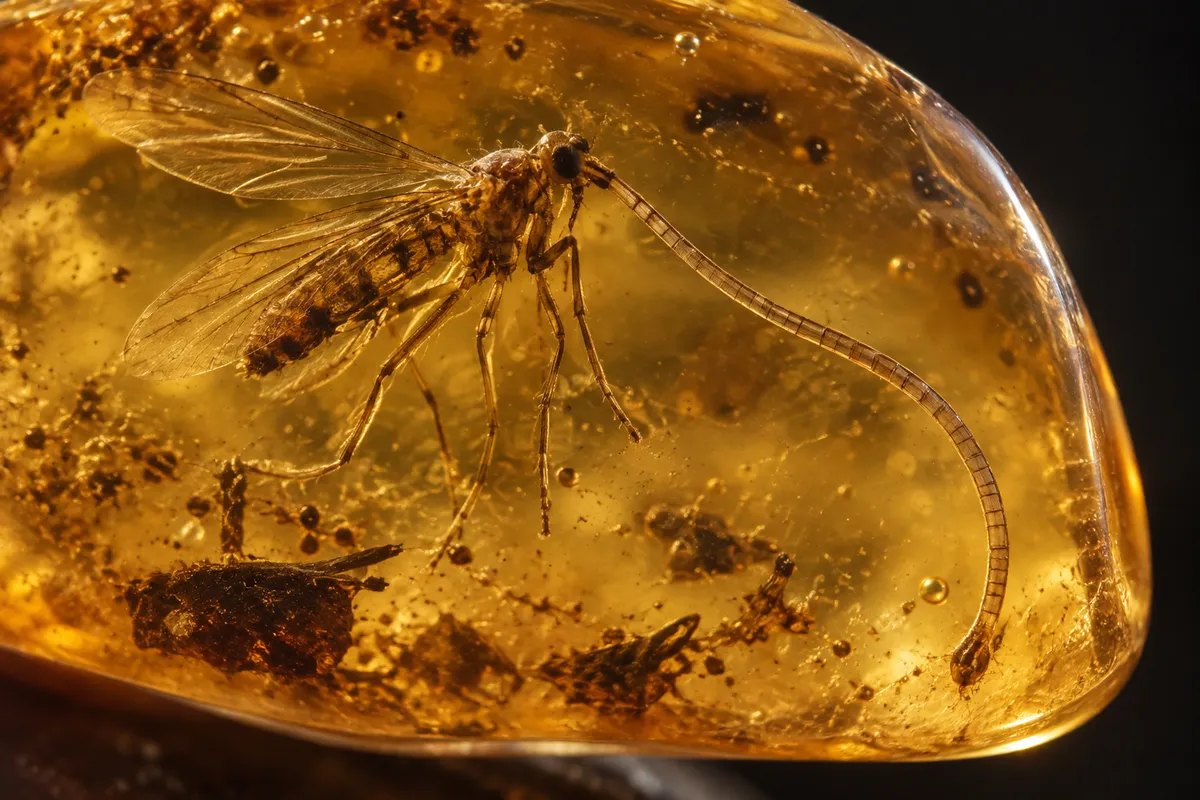
Some 99 million years ago, during the Cretaceous period, a tiny insect of a previously unknown species became trapped in tree resin. The resin hardened into amber and held the animal in place until researchers found it. They have now described it as a new species, Cretodorus noonoo.
The standout feature is its mouthparts. They are exceptionally long and flexible, nearly twice the length of the insect's body. They also have transverse folds, which are ridges running across the structure. That combination is the heart of the discovery.
How the Mouthparts Worked
Think of a bendy straw. The corrugated section lets it flex without pinching shut. The folds on this insect's mouthparts appear to do something similar, letting a very long, flexible structure bend without collapsing.
That matters because of what the insect was doing with it: piercing deep into tree bark to reach sap. A long tube is no use if it kinks or buckles on the way in. Flexibility plus fold-based support is a neat solution to that engineering problem.
To be clear about the limits here: the fossil is a snapshot, so the feeding behavior is inferred from the anatomy rather than watched in action.
Why You Won't Find This Feeding Style Today
The feeding strategy has no equivalent among modern insects, including planthoppers, which are the group this kind of comparison naturally invites. Whatever niche this animal filled, it appears to have vanished from nature.
That's one of the quiet lessons of amber. Fossils in rock usually preserve bones and shells. Amber can preserve small, delicate animals in fine detail, which means it can reveal specialized lifestyles that would otherwise leave no trace at all.
What It Suggests About Cretaceous Forests
Here's where the straw becomes a clue about the whole ecosystem. A mouth built to reach sap deep beneath bark suggests that bark was a real barrier. The likely explanation, per the reporting, is thick-barked trees growing in fire-prone environments.
That is an interpretation, not a direct observation. But the logic is easy to follow: if a specialized tool evolved to get past a defense, the defense was probably common. In this case, the insect's anatomy points to forest conditions different from the ones that support modern insects, and those conditions may have driven feeding strategies that no longer exist.
It also shows how a single species can sharpen our picture of a lost world. One tiny animal tells us something about the trees, the climate and the pressures shaping life around it.
About That Name
The species name noonoo is reportedly a nod to the Teletubbies, the children's TV characters, whose vacuum-cleaner companion is Noo-Noo. It's a fitting joke for an animal defined by a long sucking tube. Scientific naming has room for whimsy, and a memorable name helps a obscure fossil stick in people's minds.
How to Follow Discoveries Like This
You don't need a lab to appreciate amber finds. A few habits help:
- Look for the anatomy, not just the age. The "99 million years" figure grabs attention, but the real story is usually a specific body part and what it did.
- Ask what the adaptation says about the environment. Tools evolve against problems. Identify the problem and you learn about the habitat.
- Notice what's missing today. When a strategy has no modern counterpart, it signals that something about the world changed.
The next time you see a bendy straw, remember that an insect tens of millions of years older than any human invention may have solved the same problem first, and then the forests it relied on changed, and it was gone. Pick one amber discovery this month and read what its anatomy says about the world around it.