Much of the iron in the steel around you started as ancient rock layers laid down billions of years ago. For a long time, the standard explanation credited sunlight-powered bacteria for creating them. New findings from beneath Antarctica suggest that story may be incomplete: life working in the dark could have done much of the job.
By the end of this article, you'll know why the old explanation has a gap, what researchers found under the ice, and why a single protein sits at the center of the idea.
The mystery: where did all that iron ore come from?
Iron is one of the most abundant metals on Earth's surface, per a report from Phys. Yet how such massive iron ore deposits formed across geological history has long been a puzzle.
The prevailing theory has pointed to ancient photosynthetic bacteria as the main drivers. In that picture, microbes that made oxygen from sunlight helped turn dissolved iron in the oceans into solid minerals that settled out as huge deposits.
The new research challenges that idea. It suggests massive banded iron formations could form without photosynthesis at all.
What researchers found under Antarctica's ice
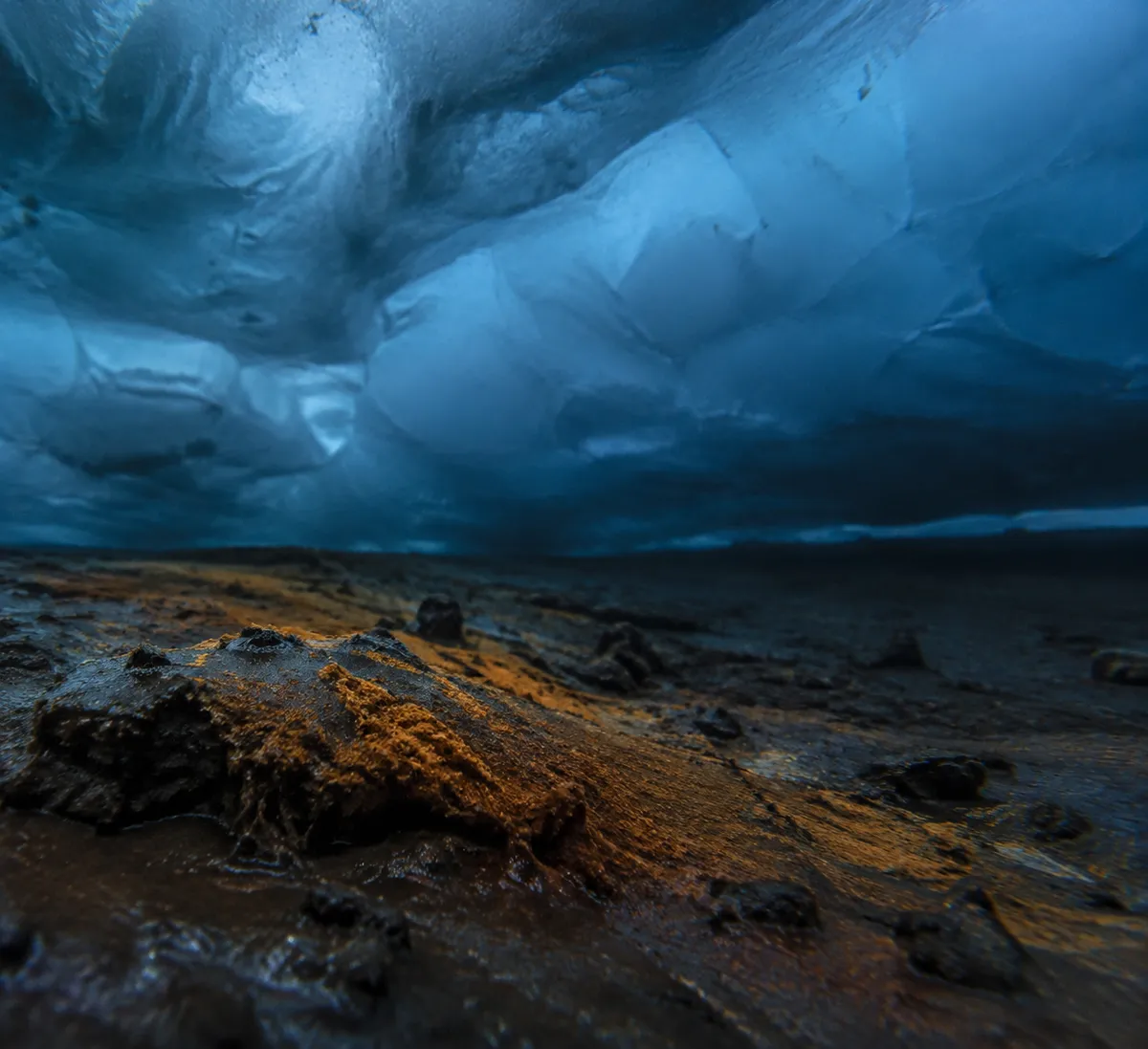
The team studied sediments beneath the Larsen C Ice Shelf in Antarctica. These sediments have very little light and very little oxygen, which makes them an unusual place for life to thrive.
There, researchers found iron-oxidizing microbes. These are organisms that take dissolved iron and chemically convert it into a form that can become solid mineral. They also found a key protein called Cyc2, tied to that process.
The significance is the setting. If iron-oxidizing life is active in a dark, oxygen-poor environment today, then sunlight-driven photosynthesis may not have been required to build iron deposits in the past.
Why Snowball Earth makes the photosynthesis story harder
Snowball Earth refers to periods when the planet is thought to have been heavily covered in ice. Under thick ice, sunlight is scarce. If iron deposits formed during those times, a purely photosynthesis-based explanation faces an obvious question: how did sunlight-dependent microbes do the work when light was blocked?
The Antarctic findings offer a possible answer. Microbes living without sunlight could have kept converting iron, even when the surface world was frozen over. That's an inference from the study's results, not a settled fact, but it fits the pattern researchers observed.
Antarctica as a stand-in for ancient Earth
Scientists can't visit the ancient oceans, so they look for places today that resemble them. Antarctic environments are used as analogs for early Earth, since they combine cold, darkness and low oxygen.
The Larsen C sediments act like a window into those conditions. Studying living microbes there lets researchers test ideas about how life could have shaped the planet under extreme circumstances, rather than relying only on rock records.
The tiny protein doing the heavy lifting
The Cyc2 protein is the molecular piece that makes the story concrete. Finding it in the Antarctic sediments links the microbes to a specific mechanism for turning dissolved iron into minerals.
That matters because it moves the idea from "it might be possible" toward "here is a tool that living organisms use." Details of exactly how the protein works go beyond what the report covers, so treat the broader claim as a promising proposal, not a final verdict on how every iron deposit formed.
What this could mean beyond Earth
If life can reshape a planet's chemistry without sunlight, the places we consider for life widen. Icy, dark environments become more interesting, whether on Earth or elsewhere. That extension is our own speculation, not a finding from the study, but it's a natural question the work raises.
What to take away
Next time you hear that photosynthesis built the world's iron deposits, add a caveat: darkness-dwelling microbes may have played a major role too. Keep an eye on follow-up studies of Antarctic sediments and the Cyc2 protein, since that's where this idea will be tested.