By the end of this article, you'll understand one of the biggest transitions in cosmic history, why the early universe was foggy, and why a tight clump of 18 galaxies is getting attention from astronomers.
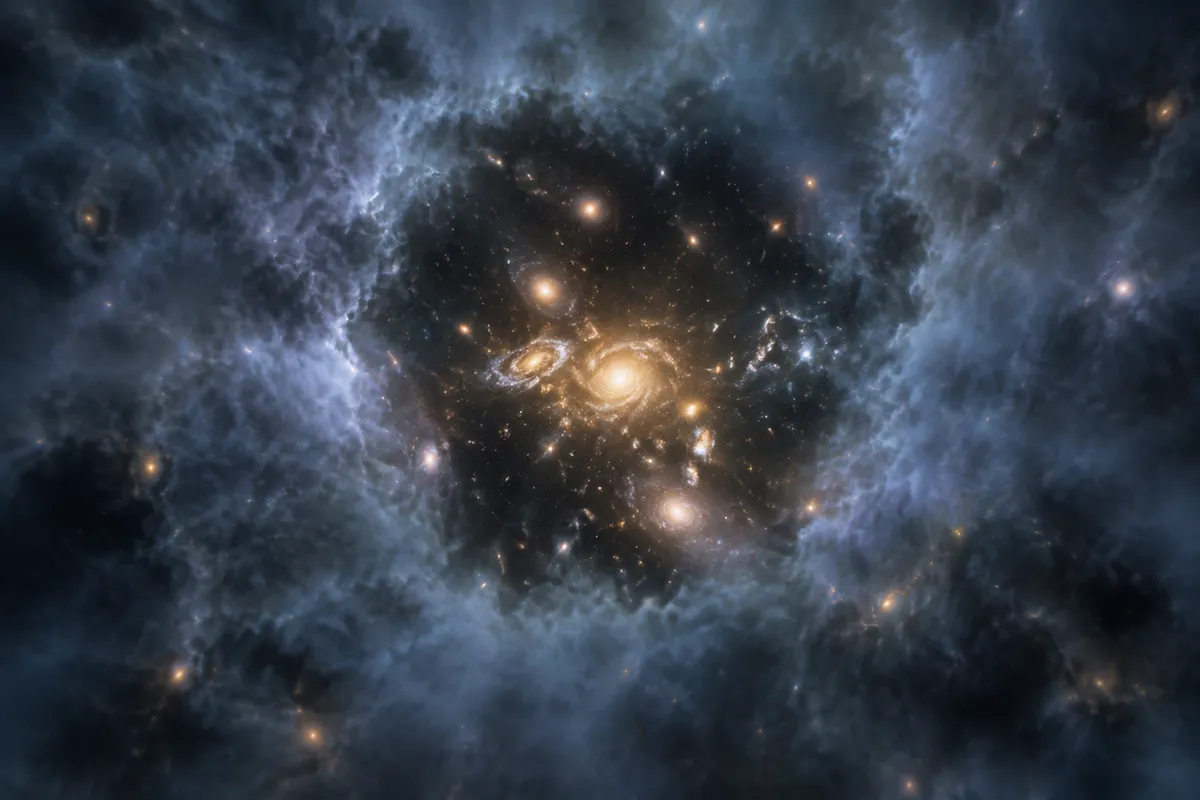
Per a report from Phys, data from the James Webb Space Telescope's JADES survey reveals a dense group of 18 galaxies, seen about 500 million years after the Big Bang. The group may be carving out a large bubble of ionized hydrogen around itself. If that holds up, it could offer some of the earliest evidence for how cosmic reionization began.
The universe used to be foggy
The early universe was filled with neutral hydrogen gas. Think of it as a fog: it blocked and scattered certain kinds of light, so the cosmos wasn't transparent the way it is today.
Cosmic reionization is the era when that changed. Energetic light from early objects stripped electrons from the hydrogen atoms, or ionized them. As ionized regions grew, light could travel through them freely, and the universe became transparent.
What an ionized bubble is
An ionized bubble is a region where the hydrogen has been ionized, surrounded by neutral gas that hasn't been. Picture a lamp switched on in a foggy room: the area around it clears first, and the clear zone grows outward.
The idea is that galaxies produce the light that clears the fog. A single small galaxy may struggle to do much. A crowd of them packed together could have a much bigger combined effect, which is why a dense group is so interesting.
Why this group stands out
The JADES observations show 18 galaxies clustered closely together, at a time roughly 500 million years after the Big Bang. According to the Phys report, this overdensity may be producing a large bubble of ionized hydrogen.
If confirmed, it would be the earliest known ionized bubble produced by a galaxy overdensity. That matters because it would give astronomers a concrete example of how reionization may have started: not everywhere at once, but in patches around crowded galaxy neighborhoods.
The Lyman-alpha puzzle
One clue astronomers use involves Lyman-alpha light, a signature emitted by hydrogen. Neutral hydrogen tends to absorb and scatter this light, so seeing it escape from the early universe is a sign that the surrounding gas has been cleared. A galaxy sitting inside a bubble would be easier to detect this way than one surrounded by fog.
This is my reading of the logic rather than a detail from the report: if a clump of galaxies is clearing its own surroundings, that gives light a path out, and that path is the kind of evidence researchers look for.
Why JWST keeps surprising people
Per Phys, JWST continues to rewrite the timeline of early galaxy formation. Each new result adds to a picture in which structure appeared in the young universe earlier than many expected. This discovery adds a possible mechanism for one of cosmology's biggest transitions, rather than just another early galaxy sighting.
What to keep in mind
The finding is described as possible, not settled. The wording from the report is that the group may be creating the bubble, and the earliest-bubble claim applies only if confirmed. Follow-up observations and analysis will be what decides it.
You can hold two ideas at once: the result is exciting, and it is a hypothesis awaiting confirmation. That's how most frontier science looks in its early stages.
The takeaway
Next time you read about the early universe, picture fog and lamps. Reionization wasn't a single flip of a switch. It may have begun as crowded galaxy neighborhoods cleared pockets of space, and this group of 18 galaxies could be one of the earliest we've caught doing it.