Dark matter is thought to make up roughly 85% of all matter in the universe, and nobody has caught a particle of it. By the end of this piece, you'll understand why the lightest candidates are so hard to detect, and how a few unusual crystals might change that. The core idea is that the detector's material may matter as much as the theory behind it.
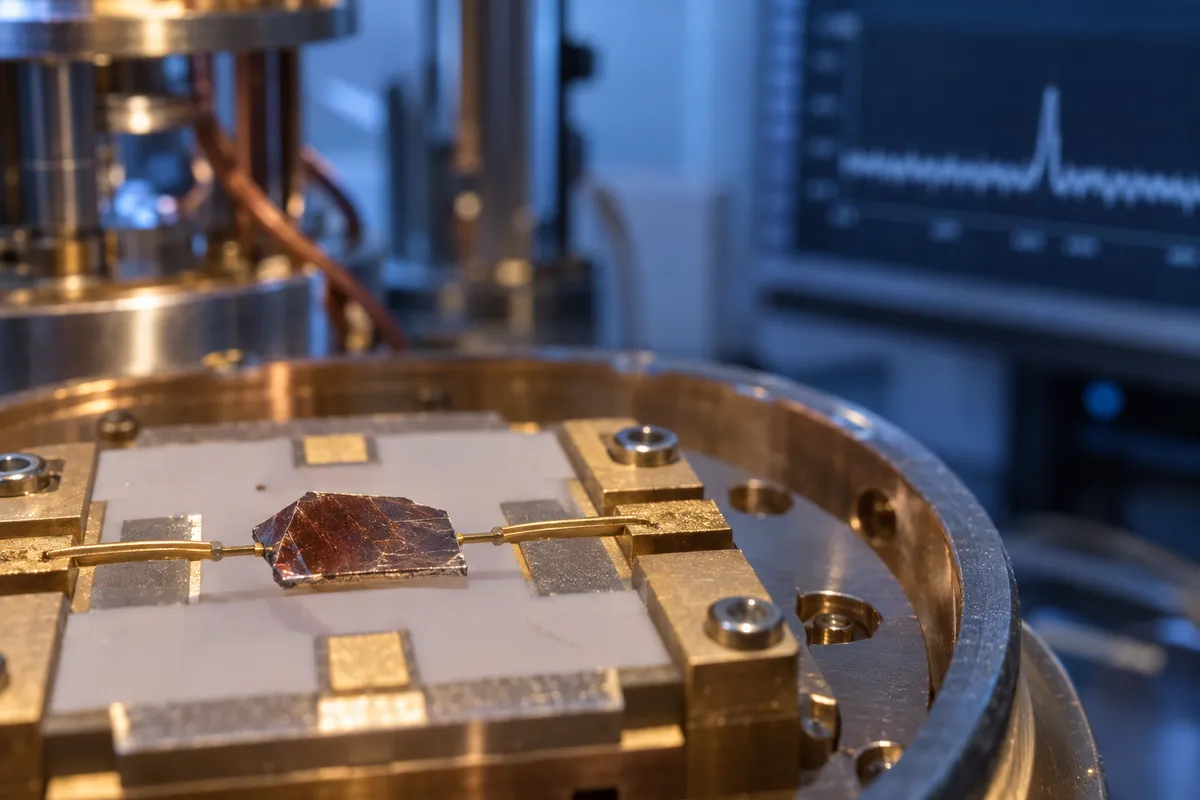
The research, as reported by Phys, points to three quantum materials: titanium diselenide (TiSe₂), strontium ruthenate (Sr₂RuO₄), and hole-doped diamond. According to the report, they could work as ultra-sensitive detectors for light dark matter and may outperform current designs by orders of magnitude. Titanium diselenide shows especially strong potential.
Why light dark matter is so hard to catch
We know dark matter is there because of its gravity, which shapes galaxies and the wider cosmos. What we haven't managed is to detect it interacting with ordinary matter in a lab.
Per Phys, traditional detection methods have struggled with the extremely weak interactions expected from lighter dark matter candidates. Think of it this way: a light particle that bumps into a detector deposits only a tiny amount of energy. If your detector can't register that nudge, the event vanishes into the noise.
That's the bottleneck. The problem isn't only that dark matter is rare or elusive. The signals it would leave behind are so small that ordinary materials can't notice them.
How quantum materials amplify a tiny signal
The proposed fix relies on low-energy plasmons. A plasmon is a collective wobble of electrons inside a material. In the materials described by Phys, these wobbles can occur at very low energies, which makes them a good match for the small energy deposits that light dark matter might leave.
The idea is amplification. A faint push from a passing particle can be turned into a signal a detector can read, instead of getting lost. Materials that support these low-energy plasmons act as a built-in magnifying glass.
This is why "unconventional" quantum materials matter here. Their electronic behavior is unusual, and that unusual behavior is exactly what makes them sensitive in a regime where standard detector materials fall short.
The three candidates
Phys names three materials. Here is what the report supports about each.
Titanium diselenide (TiSe₂)
This is the standout. The report says titanium diselenide shows especially strong potential as a next-generation dark matter detector. If you remember one name from this story, make it this one.
Strontium ruthenate (Sr₂RuO₄)
Another quantum material in the proposed lineup, able to support the low-energy plasmons that make amplification possible.
Hole-doped diamond
Diamond may be the most familiar of the three. In its hole-doped form, it joins the list as a third candidate for catching faint dark matter interactions.
I can't tell you from the available reporting how each material ranks in detail or what the exact sensitivity gains are beyond the "orders of magnitude" claim. Treat that figure as a theoretical promise, not a measured result from a running experiment.
Earth's rotation as a reality check
Any detector sensitive enough to see dark matter will also pick up plenty of false alarms. So how would researchers know a signal is real?
One angle flagged in the coverage is Earth's rotation. As the planet turns, the orientation of a crystal relative to the incoming dark matter changes through the day. Because these materials respond differently depending on direction, a genuine dark matter signal should rise and fall in a daily pattern. Ordinary background noise wouldn't be expected to follow that same rhythm.
That's my reading of the logic, not a detail I can pin to specific numbers: a repeating daily modulation would be a fingerprint that's hard for random noise to fake.
Why particle physics now needs materials science
For years, the dark matter hunt has leaned heavily on particle theory: proposing candidates and predicting how they'd behave. This work shifts some of the weight to the detector itself. Even a perfect theory is useless if no instrument can register what it predicts.
There's also a broader story. Quantum materials have often been lab curiosities, studied for their strange electronic properties. Here they become tools for answering a cosmic question, which is a nice change of role for a crystal.
What to watch next
This is a proposal for how detectors could be built, so the real test is whether these materials perform as predicted in actual experiments. If they do, the payoff would be a far more sensitive search for light dark matter than what's possible today. If they don't, we'll have learned something about the limits of these materials.
Either way, the next time you read about a dark matter search, look past the particle being hunted and ask what the detector is made of. That's where this story is moving.