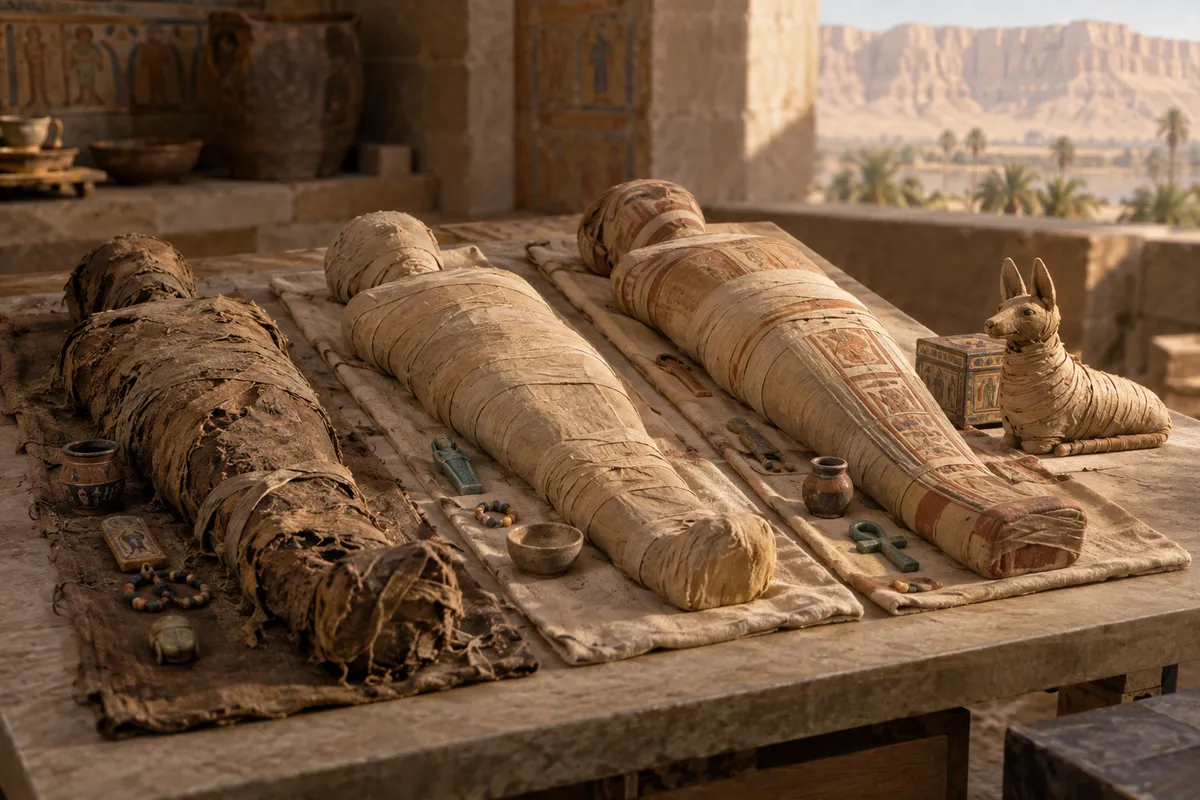
Picture an Egyptian mummy and you probably see a royal figure, arms crossed, inside an ornate sarcophagus. After reading this, you'll know why that picture is only a sliver of the story, and why a crowded tomb near Luxor is changing how researchers read "messy" ancient burials.
A team from Spain's University of La Laguna has described the remains of at least 20 ancient Egyptians and one dog in chamber three of tomb TT 209 in the Theban Necropolis, per a study in the journal Frontiers in Environmental Archaeology, as reported by Popular Science. The necropolis is a complex of more than 400 burial sites near Luxor. The remains span over 300 years, so one room records how funerary customs shifted across generations.
Why one tomb beats a dozen sites
Ancient Egyptian civilization lasted over 3,000 years, and burial traditions varied across that stretch. Normally, tracing those changes means visiting many sites. TT 209 compresses the timeline into a single chamber.
The tomb was first built during the 25th Dynasty (754–656 BCE), also known as the Nubian or Kushite Empire. The team photographed and sketched the tomb's occupants and described each mummy's orientation and position. In total, they documented nine separate funerary deposits, including single and group burials, plus personal objects and religious items.
The earliest burials were high status
According to study co-author and Egyptologist Miguel Ángel Molinero Polo, the earliest people buried here appear to have been of high social standing. They were interred in coffins, with funerary nets and amulets, and with an assemblage containing costly items.
That fits the familiar image. What came later is where it gets interesting.
Later burials changed, but care didn't fade
By the end of the 25th dynasty, which the report places at 680–404 BCE and also calls the Persian period, funerary attendants had to adjust. Space inside the chamber had become a premium. Mummies were placed wherever room was available, sometimes requiring different limb positions.
Instead of individual interments, almost two-thirds of TT 209's deceased were arranged vertically, stacked one over another. You might read that as neglect. The researchers don't.
- Many later mummies still had their arms folded over their chests, in what's known as the Osirian position.
- Molinero Polo said the vertically stacked bodies had no coffins but were carefully mummified.
- They can also be associated with upright jars, which he said point to a specific ritual not found in the tomb's earlier phases.
"Disordered" tombs may not be disordered
This is the main takeaway. Previous theories suggested some Egyptian burial sites grew more chaotic as they filled with the dead. The TT 209 findings push against that.
Co-author Jared Carballo-Pérez said in a statement: "The detailed study of the bodies indicates neither chaotic accumulation nor a loss of the original ritual over time. Rather, there was a spatial logic in which each new deposition was adapted to the presence of previous bodies—a kind of funerary memory in the processes of reuse."
He also said that deposits previously considered "disordered" can be reinterpreted. If other tombs get the same close look, some crowded chambers elsewhere could turn out to tell a similar story. That's our inference, not a claim from the study.
The dog on top
In one case, a mummified dog was placed directly on top of a man and a woman. The study's figure notes the canid (labeled M9) lies over the lower limbs of two closely superimposed individuals.
Carballo-Pérez said: "I find it quite beautiful. This could indicate a close relationship between these human individuals and the animal, an idea that I think is quite easy to empathize with."
Note his wording: "could indicate." The placement is documented, but the emotional meaning is an interpretation, not something the evidence proves.
How to use this when you read about Egypt
A few habits are worth borrowing from this study:
- Don't assume "mummy" means "king." The standard image is one tradition among many, in a civilization that lasted over 3,000 years.
- Treat crowding as a clue. Packed tombs may reflect planning around earlier burials rather than a breakdown of ritual.
- Look at positions. Folded arms in the Osirian position persisted even when space got tight, a sign that ritual continued.
- Hold interpretations loosely. The dog's story is plausible and moving, but it remains an interpretation.
The next time you see a tidy museum sarcophagus, remember TT 209: ask what the people who came later did with the space that was left, and how carefully they did it.