You can stop worrying that reality might suddenly rewrite itself. A new study, reported by Phys, proposes a reason the universe may be unable to leave its current state: quantum interactions in the early universe may have "locked" fundamental fields into the energy states they occupy today.
Below is what that means, why physicists care, and how an idea borrowed from quantum computing plays into it.
The worry: a universe that could change its mind
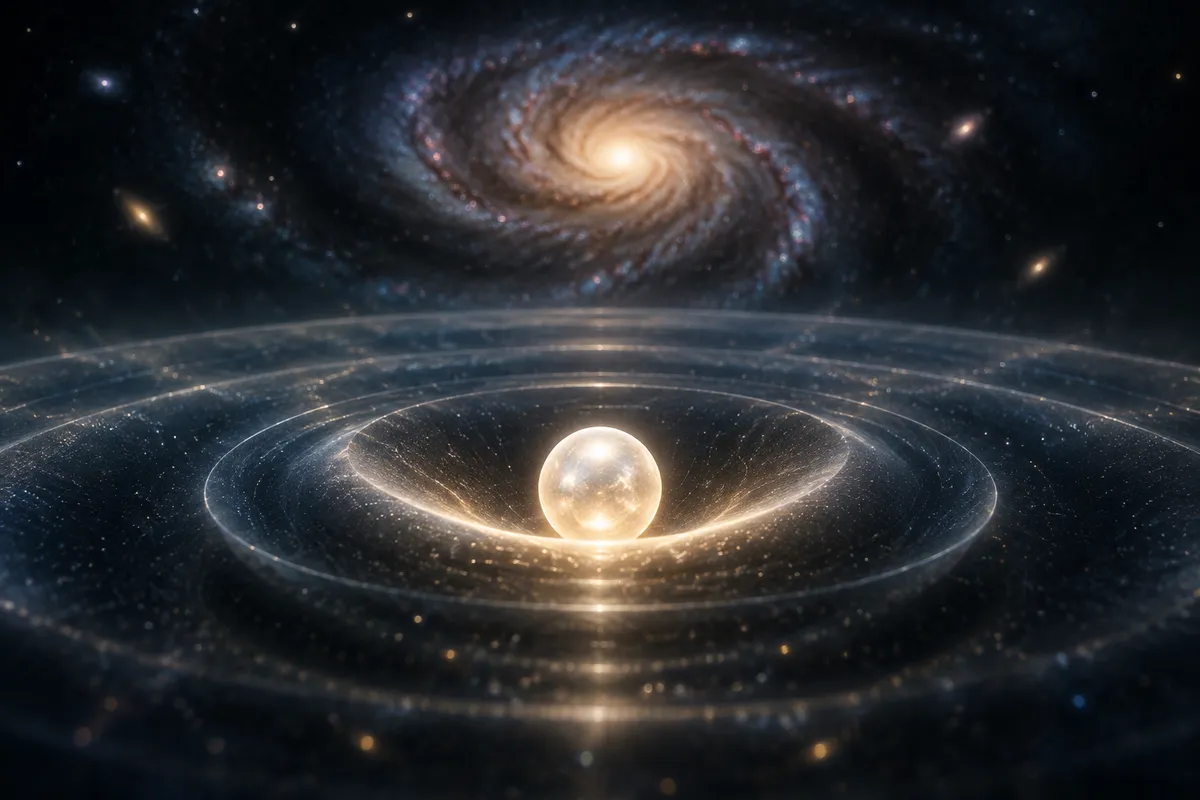
Physicists have long entertained an uncomfortable possibility. Some fundamental fields, the Higgs field being the best-known example, might sit in what is called a "false vacuum." Think of a ball resting in a shallow dip on a hillside. It looks settled, but a deeper valley lies below.
In quantum mechanics, a system can sometimes tunnel into a lower-energy configuration even without enough energy to climb over the hill between. If a cosmic field did that, per the framing in the Phys report, it could spontaneously shift and fundamentally alter reality.
The universe has not done this. The new research asks why.
The proposed answer: interactions that freeze things in place
According to Phys, the study suggests that quantum interactions in the early universe may have locked fields into their current energy states, preventing the tunneling into lower-energy configurations. In other words, the universe may be trapped in its own comfort zone, and the study helps explain why it cannot seem to leave.
The work was helped along by a researcher in a College of Engineering and Computer Science, a clue that the toolkit here comes from outside traditional cosmology.
Where quantum computing comes in
The study applies principles from quantum information science. Two related ideas are relevant, and both are familiar to anyone who follows quantum computers:
Decoherence
Quantum computers are fragile because their delicate quantum states get disturbed by interactions with their surroundings. That process is called decoherence. Here the same logic is turned around: interaction with the environment can keep a system from drifting into a different quantum outcome.
The quantum Zeno effect
This is the idea that repeated observation or environmental interaction can freeze a quantum system in place, like a pot that never boils because you keep watching it. The report framing from Phys points to this kind of effect as a way interactions can hold a system steady. I would add a caution: the report as summarized does not spell out exactly how closely the study's mechanism follows the Zeno effect, so treat that link as an illustration rather than a confirmed detail.
Why this matters beyond the thought experiment
The appeal is that it connects two fields that rarely overlap. Quantum information science is advancing quickly, and this research suggests its concepts can help address questions about the early universe, and, by extension, the long-term stability of the cosmos.
It also changes the tone of an old worry. Instead of asking only "could the universe tunnel into a new state?", researchers can ask what in its history may have made that unlikely or impossible.
What we do not know yet
A few honest limits apply:
- This is a proposal. A study suggesting a mechanism is not the same as proof that the universe works this way.
- The details available here are limited to the Phys summary, so specifics such as the exact models, numbers, or tests are not covered.
- Whether the Higgs field is truly in a false vacuum is itself a question the study responds to, not one it settles in this account.
The takeaway
When you hear that the universe "could" spontaneously change, remember that possibility is only half the story. Ask what keeps things stable. This research suggests the answer may be written into the earliest interactions of the cosmos, and that tools built for quantum computers may help us read it. Look for the full study and follow-up work to see whether the idea holds up.