By the end of this article, you'll know how a toad hunts in muddy water without good eyesight, how a snake builds a heat map of its dinner, and how a baby sea turtle finds its way across an ocean. Amphibians and reptiles run on senses that go well beyond the usual five, according to a feature from Phys.
The best way in is through one of the strangest frogs on Earth.
The Surinam toad: a hunter that feels its food
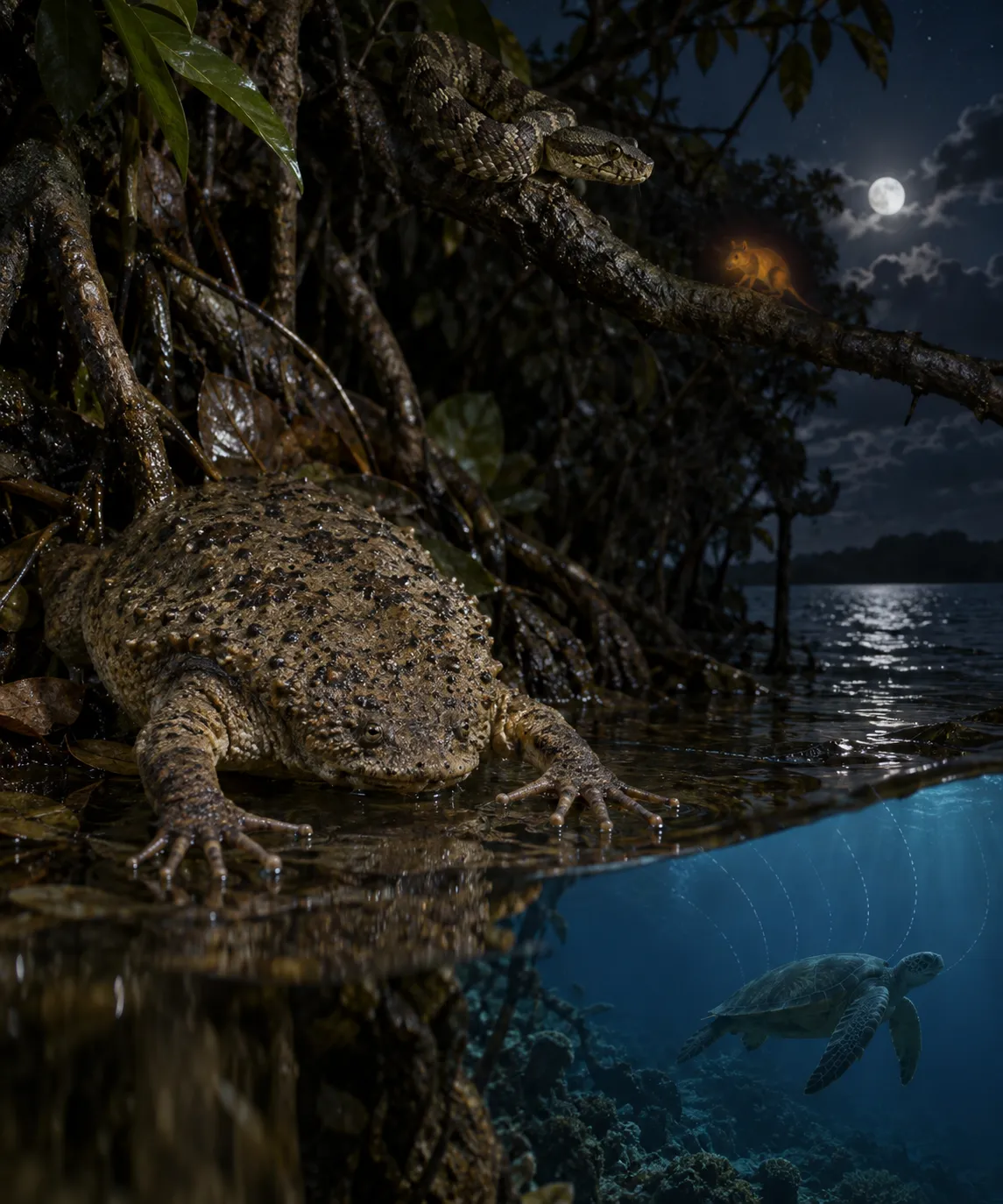
Per Phys, the Surinam toad is flat-bodied and tiny-eyed, and it's adapted to the murky waters of the Amazon basin. Its vision is very poor, yet it hunts well. Sight isn't the tool it relies on.
Instead, it uses its fingertips. Phys reports that the toad's fingers carry 128 sensory lobes that detect water vibrations, which works even in total darkness. When a fish swims close, the disturbance in the water tells the toad something is there.
The practical lesson is that a "bad" sense doesn't make an animal a poor hunter. In water too cloudy for good vision, touch can do the job better.
Pit vipers: a heat map of prey
Pit vipers have infrared detection. Their pit organs build a heat map of nearby prey, a picture invisible to human eyes. For a snake, a warm body against a cooler background stands out, whether or not there's enough light to see it.
If you've ever seen thermal-camera footage, you have a rough idea of what that view looks like. The comparison is ours, not the snake's, and nobody can say exactly what it feels like from the inside. But it shows why darkness is no shield for a small warm animal.
Sea turtles: a built-in compass
Sea turtles have magnetoreception, the ability to sense Earth's magnetic field. Per Phys, young turtles use it to navigate ocean journeys of around 8,000 miles, treating the field like a natural GPS.
That is a remarkable trip for an animal that has never made it before. It suggests that some of the map is part of the turtle's biology rather than something learned along the way. That's our reading of the facts, not a claim from the report.
Why frogs sit so still
Frogs have what's called cutaneous mechanoreception: skin that picks up mechanical disturbances. According to the Phys feature, this lets them monitor danger without moving. That matters because movement attracts predators. A frog that can feel trouble approaching can stay frozen and keep its cover.
Next time you see a frog that won't budge, it may not be oblivious. It may be listening with its skin.
The forked tongue: tasting the air
Snakes use their forked tongues to taste the air, which helps them hunt and find mates. The flicking tongue is gathering information, not just tasting in the way you taste lunch. It's a reminder that chemical sensing is a major part of how these animals read their surroundings.
Why this matters for conservation
Understanding what animals sense helps us understand how they live. Phys frames this against accelerating biodiversity loss: knowing the sensory worlds of amphibians and reptiles deepens our appreciation of their ecological roles and survival strategies. The feature stops short of spelling out specific conservation measures, so take this as a general principle rather than a checklist. An animal that navigates by magnetic fields, or hunts by water vibration, lives in a world shaped by cues we rarely think to protect.
Try seeing it their way
Next time you're near a pond, a beach or a reptile exhibit, pick one animal and ask what information it would be using right now: vibration, heat, magnetism, taste or touch. Watching with that question in mind changes what you notice.