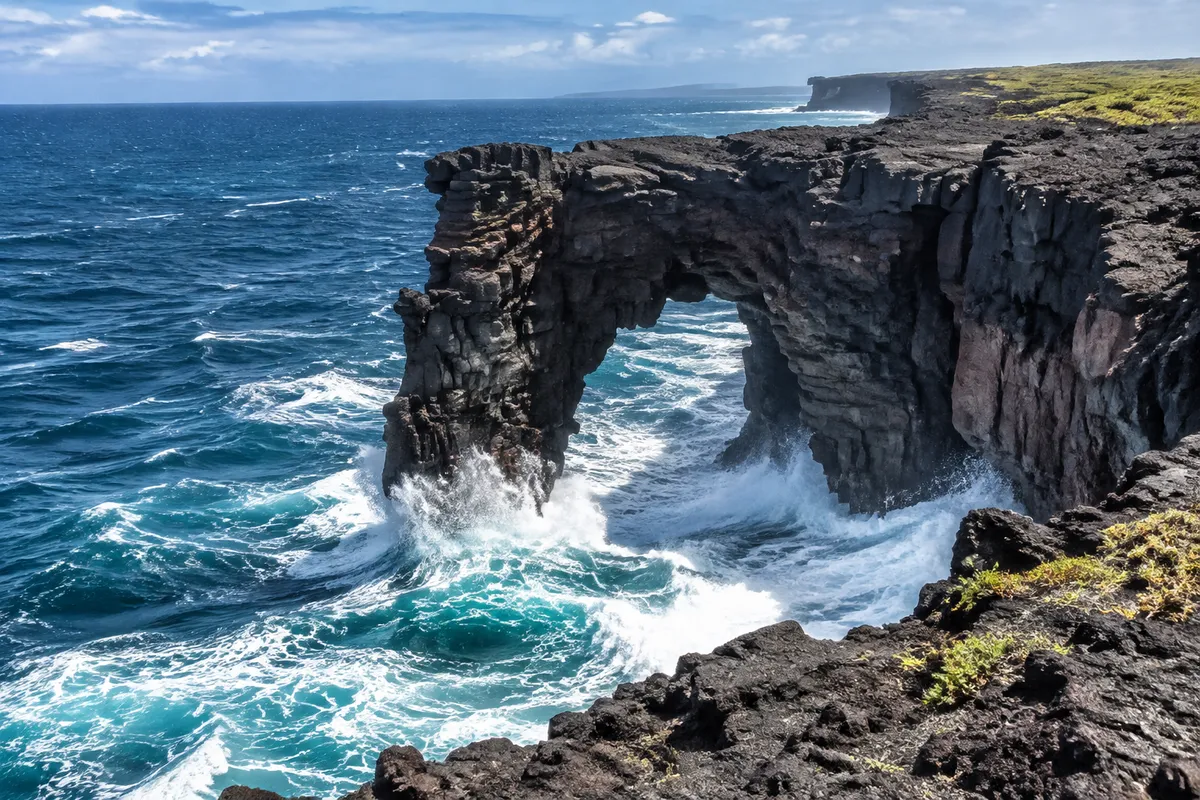
The Hōlei Sea Arch, one of the best-known natural landmarks at Hawaiʻi Volcanoes National Park, has collapsed into the ocean, according to Travelpulse. A formation shaped by volcanic activity and erosion over centuries is now gone.
By the end of this piece, you'll understand how a sea arch like Hōlei gets made, why every one of them is on a countdown, and how to plan a coastal visit that doesn't depend on a single landmark staying put.
A caveat up front: the report we have is brief. It confirms the collapse and the arch's origins, but it doesn't say when the collapse happened, what triggered it, or whether anyone was nearby. We won't guess at those. What we can do is explain the general process that makes arches fragile.
How a volcanic sea arch is born
The short version, per the report: volcanic activity builds the rock, and erosion carves it. Lava flows into the sea and hardens into a coastline. Then the ocean goes to work on it for centuries.
The general geology of arches follows a familiar pattern (this is standard coastal science, not detail from the Travelpulse report):
- Waves attack weak spots. Cracks and softer layers in the rock get pounded and widened.
- A cave forms. Repeated wave action hollows out a notch at the base of a cliff or point.
- The cave breaks through. If the hollow cuts all the way through a narrow headland, you get an arch.
- The arch thins. Waves and weathering keep removing rock from the underside and the supports.
That last step never stops. An arch is a stage in a process, not a finished product.
Why arches don't last
The same forces that make an arch are the forces that end it. Nothing has to go wrong for an arch to fall; it just has to keep being an arch. Each wave removes a little more support, and eventually the span can no longer hold its own weight.
That's why geologists tend to treat sea arches as temporary features. Hōlei lasted centuries by the report's account, which is a long run by human standards and a blink by geological ones.
What the collapse says about changing coastlines
The Travelpulse report frames the collapse as a reminder of how quickly iconic places can vanish, pointing to climate change, erosion, and environmental shifts. It's worth being careful here: the report doesn't say what caused this specific collapse, and an arch can fall from ordinary erosion alone. Our read is that the event is best understood as a vivid example of coastal change rather than proof of one cause.
Still, the broader point holds for anyone who travels to see natural wonders. Coastal features are among the most changeable landmarks on Earth, and what you see in a photo may not match what's there today.
How to plan a visit when landmarks can change
You can't predict a collapse, but you can make your trip more resilient.
Check current conditions before you go
Visit the park's official website or visitor center for current information on open areas and closures. Photos online, including ones on this very site, can be years out of date.
Don't build a trip around one feature
Hawaiʻi Volcanoes National Park is known for volcanic landscapes shaped by the same forces that built Hōlei. Treat any single formation as a bonus, not the whole itinerary.
Respect posted warnings near cliffs and shorelines
Coastal rock that is eroding is unstable by nature. Stay behind barriers and signs. Nobody should treat the edge of an eroding sea cliff as a photo prop.
Capture what you see
If you've visited Hōlei, your photos are now a small piece of a record that can't be recreated. Date them and note where you took them.
The takeaway
Loss like this is a reason to go see places while they exist, but also to look closely at what is there now. Next time you stand at a coastline, notice the cracks, the hollows, and the waves doing their slow work, and plan your trip around the whole landscape rather than one famous shape.