Tiny insect remains can tell you things bones and artifacts sometimes can't: what a place was used for, in what order, and how quickly the dead were laid to rest. A recent study of a cave on Gran Canaria shows how, and by the end of this article you'll understand how archaeologists read that kind of evidence.
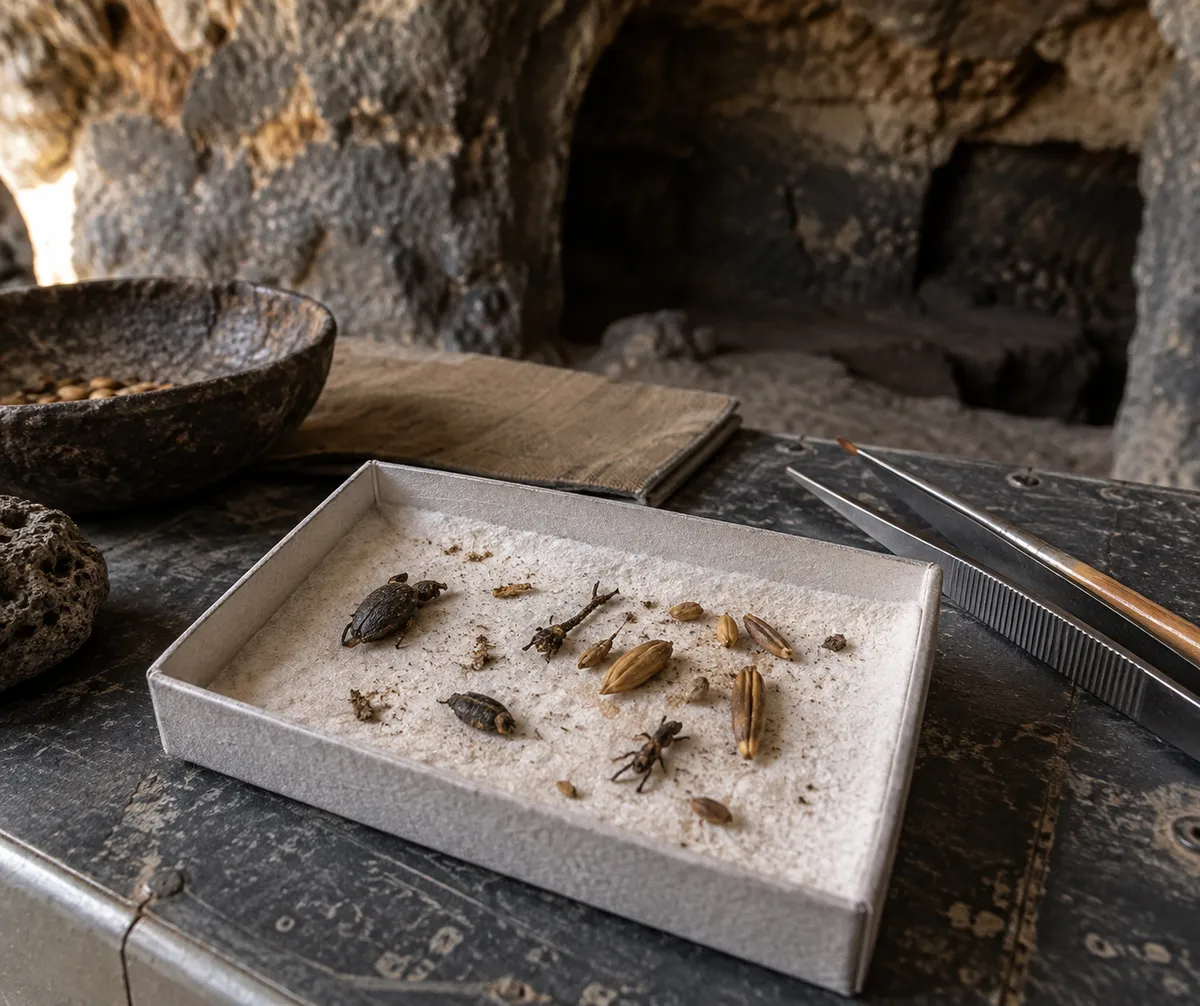
Per a report from Phys, archaeologists analyzed more than 8,000 preserved insect remains from Cruz de la Esquina, a funerary cave on Gran Canaria dated to the 7th to 9th centuries AD. Their conclusion: the cave was used by the island's Indigenous people as a grain storage site before it became a burial cave.
A Cave With Two Lives
The most striking finding is the cave's change of purpose. Before it held the dead, it reportedly held food. The insects are what point to this. Certain species thrive around stored grain, so their remains act like a fingerprint of what was once kept there.
That gives the site what you might call a biography: first a granary, later a burial place. Without the insect evidence, a cave full of human remains would likely just look like a burial cave, full stop. The earlier chapter would be invisible.
What Insects Say About Death Rituals
The second finding concerns the dead themselves. According to the study as reported by Phys, the insect evidence suggests bodies were deposited in the cave shortly after death. That challenges earlier ideas that bodies underwent a period of decomposition elsewhere before being placed in the cave.
The logic is easy to follow. Insects are drawn to bodies at particular stages, so what species turn up, and in what condition, can hint at the state of a body when it arrived. If the pattern fits fresh deposition, a long pre-burial decomposition phase becomes harder to argue.
I'd treat this as a significant revision to one idea about this site, not a final word on every burial tradition in the Canary Islands. The reporting describes it as a challenge to earlier assumptions, and further work would be needed to see how widely it applies.
Why Archaeoentomology Is Worth Knowing
The field behind this is archaeoentomology: the study of ancient insects found at archaeological sites. Think of it as the forensic entomology you may know from crime stories, pointed at the distant past.
Its appeal is simple. Insect remains are often overlooked, yet they're everywhere people lived, stored food, and buried their dead. Here, more than 8,000 of them were enough to reconstruct both a change in a site's use and a detail about how funerals worked.
How to think about it
- Insects follow resources. Grain, food waste, and bodies all attract specific species.
- Presence tells you what was there. A grain-loving insect suggests stored grain.
- Condition and timing matter. Which insects appear, and when, can hint at the sequence of events.
These are general principles of the method; the details of how this team applied them are in the original study.
Why This Matters for Canary Islands History
Per the report, much of the Indigenous history of the Canary Islands was disrupted or lost after the Spanish conquest. That makes any new, physical evidence valuable. Written records from the conquest era can't be the whole story, and the ground itself, down to the smallest remains, can fill gaps.
This study adds rare detail: that a community stored grain in a cave, and later used it to bury their dead soon after they died. Those are ordinary, human decisions, and they bring the island's Indigenous people into sharper focus.
Takeaway
Next time you see an archaeological headline about bones or tombs, ask what else was in the dirt. Often, the smallest evidence, like 8,000 insect fragments, is what changes the story.