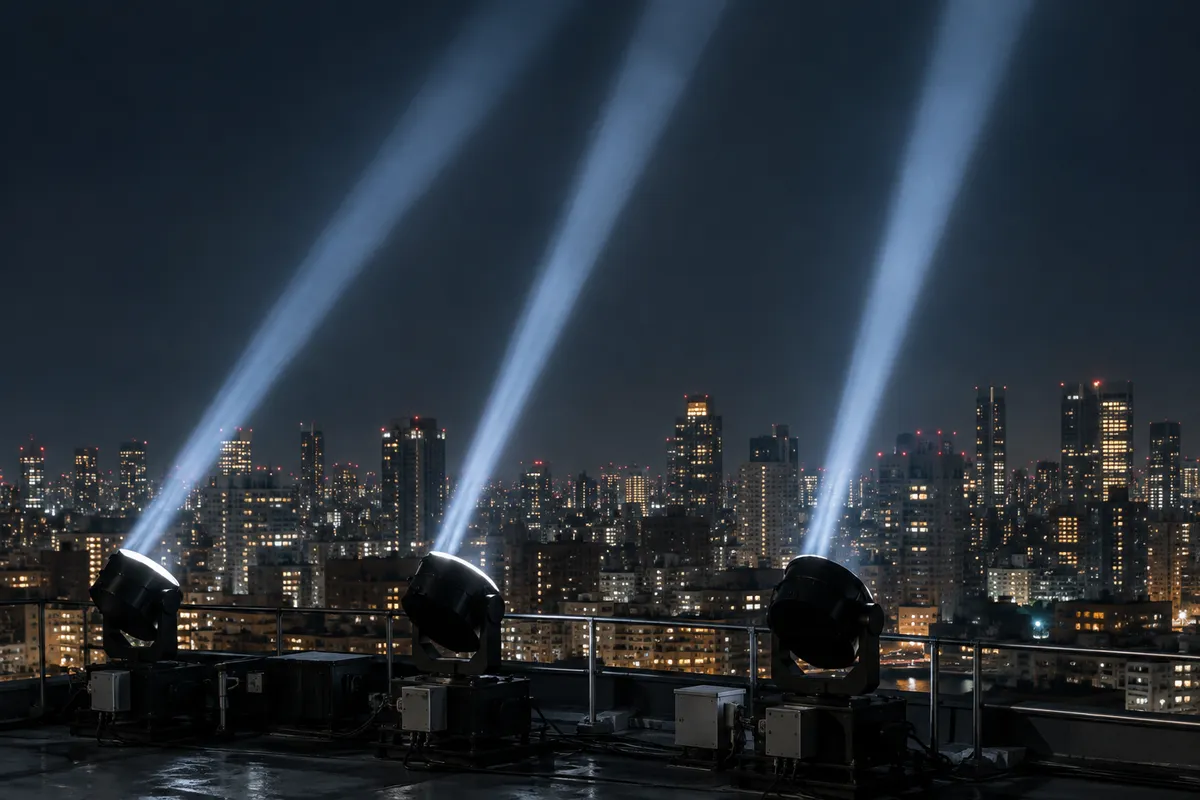
Bright beams of light stabbing into the sky over New Jersey and New York City got people talking about the unexplained. The answer, per USA Today, turned out to be much more ordinary: powerful searchlights, likely from a nearby event or venue.
That's a satisfying ending, but the better payoff is what comes after it. Once you know how this kind of mystery usually resolves, you can run a quick check on the next odd light you see, and you'll be less likely to share a wrong guess.
What happened over NJ and NYC
According to USA Today's report, people in New Jersey and New York spotted mysterious bright beams in the sky. The sightings drew attention because nobody could immediately say where the light came from. The explanation, per the outlet, was powerful searchlights, probably tied to a nearby event or venue.
The reporting as summarized here doesn't pin down which event or venue was responsible, so treat that part as "likely" rather than confirmed. What's established is the basic finding: the beams came from searchlights, not from anything exotic.
Why a searchlight looks so strange from far away
I can't tell you the specifics of this case beyond the report, but the general logic is easy to follow. A searchlight is built to be seen. It throws a narrow, intense column of light upward, and that is not something most of us look at on a normal night. When you see it from a distance, with no obvious source on the ground, your brain has nothing to anchor it to. A beam that seems to come from nowhere feels like a sky event rather than a ground one.
That gap between what you see and what you can place is where mystery lives.
A quick checklist for any strange sky light
Next time something odd lights up the sky, try these steps before you post or panic.
1. Look for a fixed point of origin
Do the beams seem to come from one spot on the horizon? Light that traces back to a single ground location points toward a lamp or searchlight, not something floating in the sky.
2. Think about what's happening nearby
The NJ and NYC explanation pointed to a likely nearby event or venue. Big openings, promotions, and gatherings are natural places to look. A quick search for local events can solve the puzzle in minutes.
3. Watch whether it moves like a machine or a sweep
If the beams hold position or sweep in a pattern, that is consistent with equipment being operated by people. Anything you can't explain by those habits deserves a second look, not a leap to a conclusion.
4. Check local news and official accounts
The fastest debunk in this case came from reporting. Local outlets and city or venue accounts often explain these things quickly. If nothing turns up, that is a reason to stay curious, not to assume the worst.
5. Hold off on sharing until you've done steps 1 to 4
This is the one that matters most. Unexplained lights spread fast online, and speculation usually travels faster than the explanation does.
Why we jump to UFOs first
This part is my analysis, not something from the report. When we see something we can't identify, the dramatic explanation is often the most memorable one. "Aliens" is a more exciting story than "someone's searchlights," so it gets shared first. The tag list on this story even includes UFO, which hints at how the conversation likely started.
None of that makes curiosity a bad instinct. Wondering what's up there is exactly how people end up learning something. The trick is to treat the wild guess as a question to test rather than an answer to repeat.
Mystery solved is still a good story
The New Jersey and New York beams are a tidy example of the cycle: something strange appears, people speculate, and a plain explanation arrives. It's worth appreciating that the system worked. Someone asked what the lights were, and reporting found an answer.
So the next time a beam shows up on the horizon, find where it starts, check what's happening nearby, and wait for the explanation before you share the theory.