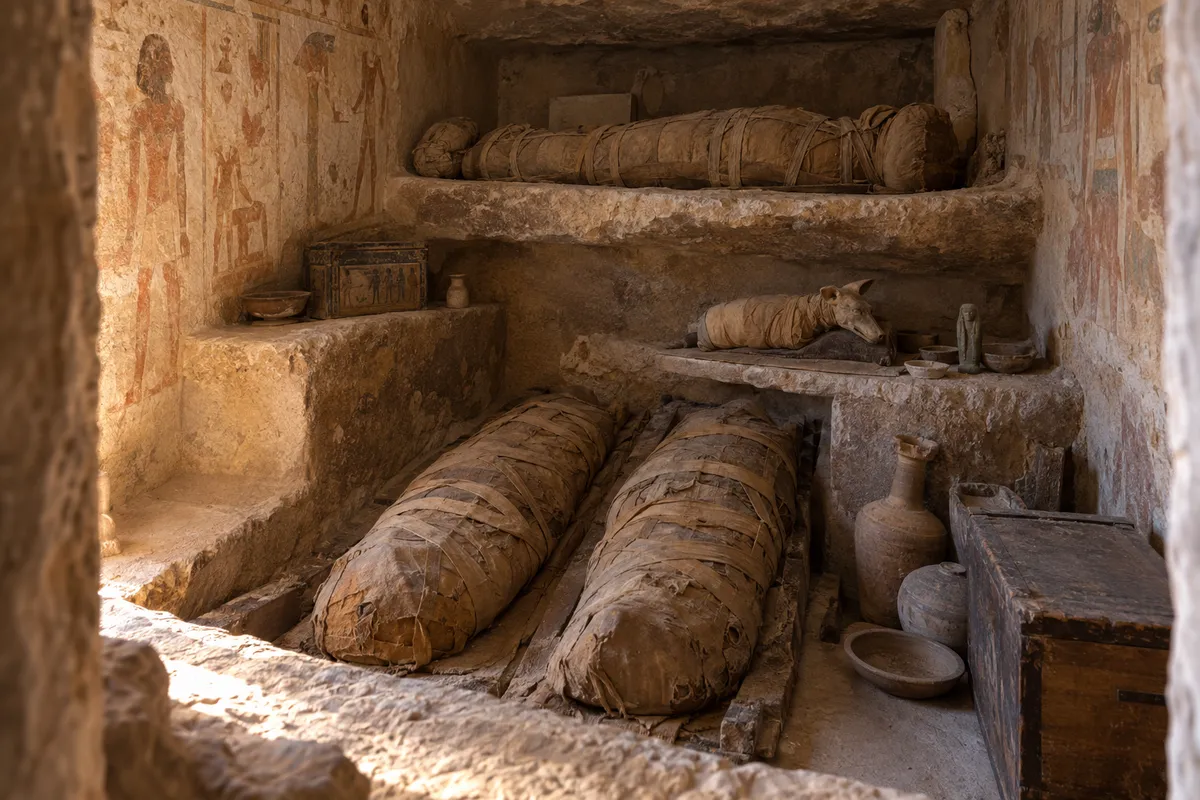
Open a tomb crammed with bodies from many centuries and your first thought is probably that things got out of hand. A new study of one burial chamber near Luxor suggests that thought is wrong, and it gives you a better way to read any layered archaeological site: look for the rules, not just the pile.
The study, as reported by Phys, examines Theban Tomb 209, a chamber that was reused from the Twenty-fifth Dynasty through the Ptolemaic period. That is a long stretch of time for one space to keep receiving the dead. The researchers argue that the crowded later burials were not chaotic. Instead, they followed an evolving "funerary memory" that adapted rituals around the bodies already there.
What the study actually claims
The core claim is simple. People who buried their dead in Tomb 209 over many generations were not just squeezing bodies into leftover space. According to the report, they were working within a set of ideas about how a burial should be done, and those ideas shifted as the tomb filled up.
That matters because the older assumption is that reused ancient tombs gradually turned disordered. The findings, per Phys, offer a more nuanced view: later mourners had to deal with earlier burials, and they adjusted their rituals to do so rather than abandoning tradition.
What "funerary memory" means in plain terms
Think of a family cemetery plot where each new burial has to respect what is already there. Nobody writes down every rule, but people remember how things were done, change a few details when circumstances demand it, and pass that on.
That is roughly the idea behind funerary memory as the researchers describe it: a tradition that is remembered and adapted, not frozen. Under this reading, a tomb is less like a storage room and more like a document that many hands edited over time.
Why a tomb that looks messy may be planned
This is the most useful lesson from the study, and you can apply it elsewhere.
- Crowding is not the same as disorder. A packed chamber can reflect deliberate choices about where and how to place each person.
- Later burials respond to earlier ones. The arrangement you see is a conversation across centuries, not a single event.
- Change is part of the tradition. Adapting a ritual to a new situation is not a breakdown of practice. It is how practice survives.
The reported conclusion is that Egyptian burial behavior in this tomb was more flexible and more socially aware than the "it just got messy" story allows.
The mummified dog over two humans
One detail makes the study easy to remember: a mummified dog placed over two humans. It is the kind of find that makes a distant culture feel close, because it speaks to companionship and to grief.
We should be careful about what we claim here. The source material does not tell us why the dog was placed there, and any explanation is interpretation. Still, it is reasonable to say the placement shows animals could have a place in how Egyptians imagined the afterlife, and it fits the researchers' broader point that these arrangements were purposeful rather than random.
How to read a layered site yourself
You will not be excavating in Luxor anytime soon, but the approach travels well to museum exhibits, documentaries, and news about digs.
- Ask who came first. The earliest burial often shapes everything after it.
- Look at placement. Position of bodies, including animals, may carry meaning.
- Treat time spans as a clue. Reuse across many centuries, from the Twenty-fifth Dynasty to the Ptolemaic period here, means traditions were being actively maintained.
- Be suspicious of the word "chaotic." It often says more about our assumptions than about the people who made the space.
What we still don't know
The report summarized here does not give details on how many burials the chamber held, who the individuals were, or what exactly changed at each stage. Those specifics would sharpen the picture, and they are worth looking for in the full study. The big idea, though, stands on its own: reuse can be a sign of continuity.
The takeaway
Next time you see a crowded tomb, or any layered historical site, ask what rules the people were following before you decide they had none. Tomb 209 suggests order can hide in plain sight.