By the end of this piece, you'll understand how a warming ocean and a black-market pet trade can team up against one species, and how to avoid feeding the trade yourself.
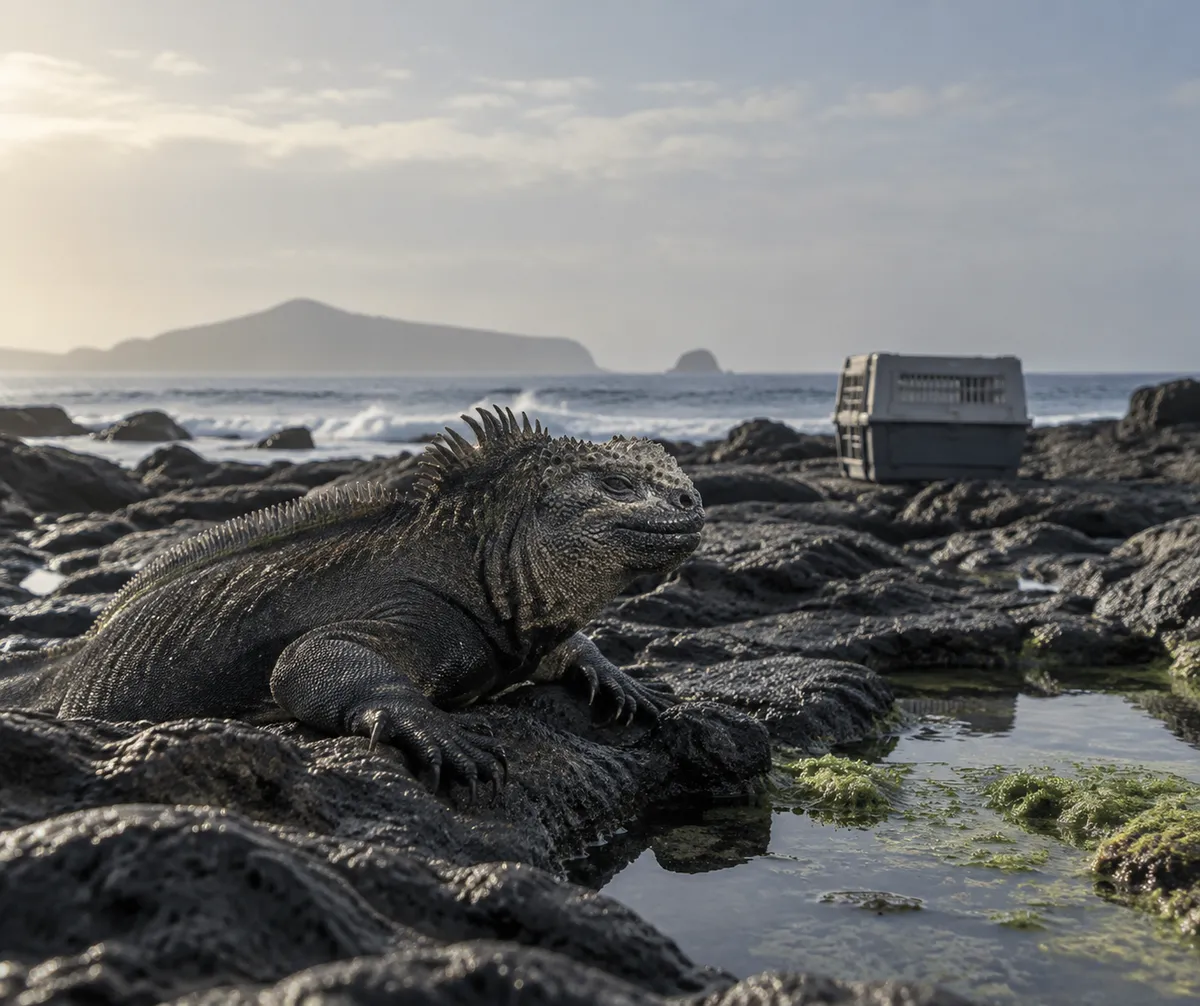
Per a report from Phys, scientists are alarmed that Galapagos marine iguanas are caught between two pressures at once. A super El Niño, the 2026/27 event, is damaging the algae the iguanas eat. Meanwhile, trafficking for the exotic pet trade is rising, with what the report describes as a "strange uptick" in iguana trafficking and recent seizures in Ecuador.
The angle worth your attention: these threats aren't separate. One weakens the animals, the other removes them, and the combination can push an already vulnerable species toward collapse.
Why the two threats compound
Per the Phys report, the super El Niño is intensifying pressure on marine ecosystems, and species already at risk become more likely to collapse. Marine iguanas depend on algae as their food source. When that food is destroyed, the population gets thinner and more stressed.
Now add a second drain on the same population. Trafficking networks pull animals out of the wild, and a stressed species has less room to absorb those losses. Think of a bank account: El Niño cuts the income, traffickers make withdrawals. Either might be survivable alone. Together, the balance heads toward zero. (That analogy is ours, not the researchers'.)
What a super El Niño does to marine iguanas
Marine iguanas are unusual. They are among the Galapagos' most distinctive animals, and their dependence on ocean algae is a big part of why they matter. That's also their weak point.
The Phys piece reports that the super El Niño is destroying that algae. For an animal whose diet comes from one marine source, there's no easy plan B. You can't simply tell a reptile to switch menus when its food supply is wiped out.
This is why climate stress isn't an abstract backdrop here. It directly attacks the base of the iguanas' survival.
How trafficking slips through legal cracks
The report points to loopholes in wildlife trade permits as part of the problem. One flagged issue: "captive bred" permits can hide wildlife trafficking.
Here's the logic, in plain terms. A legitimate permit says an animal was bred in captivity rather than taken from the wild. If paperwork can be obtained or misused without strong verification, a wild-caught animal can be laundered into the legal market with a document that looks fine. The buyer may never know.
The report also says organized crime is exploiting conservation weak spots, and that trafficking networks appear to be adapting faster than enforcement systems. Recent seizures in Ecuador, it notes, point in that direction.
What you can do as a buyer
If you care about wildlife and might ever buy an exotic pet, a few practical habits help. These are common-sense steps rather than findings from the report:
- Be suspicious of rare species for sale. If an animal is native to a protected, remote place, ask how it could legally be available at all.
- Don't treat a "captive bred" label as proof. Ask for documentation and who issued it, and be wary if the seller gets vague.
- Favor common, well-established captive-bred species over anything tied to a vulnerable wild population.
- Walk away from unusually cheap or easy deals on rare reptiles.
- Report suspicious listings to your local wildlife authority.
Demand is the part consumers control. Trafficking networks exist because someone pays.
Why this story is bigger than one lizard
The marine iguana is a vivid example of a pattern: environmental shocks and black-market demand multiply each other. Climate pressure makes species fragile, and fragile species are the ones that can least afford to lose individuals to poaching.
The Phys report frames converging climate stress, organized crime and permit loopholes as a threat to a species that was already vulnerable. We can't fix an El Niño. We can refuse to be the market on the other end of the trade.
The single most useful step: before you buy any exotic animal, verify where it came from, and if you can't, don't buy it.