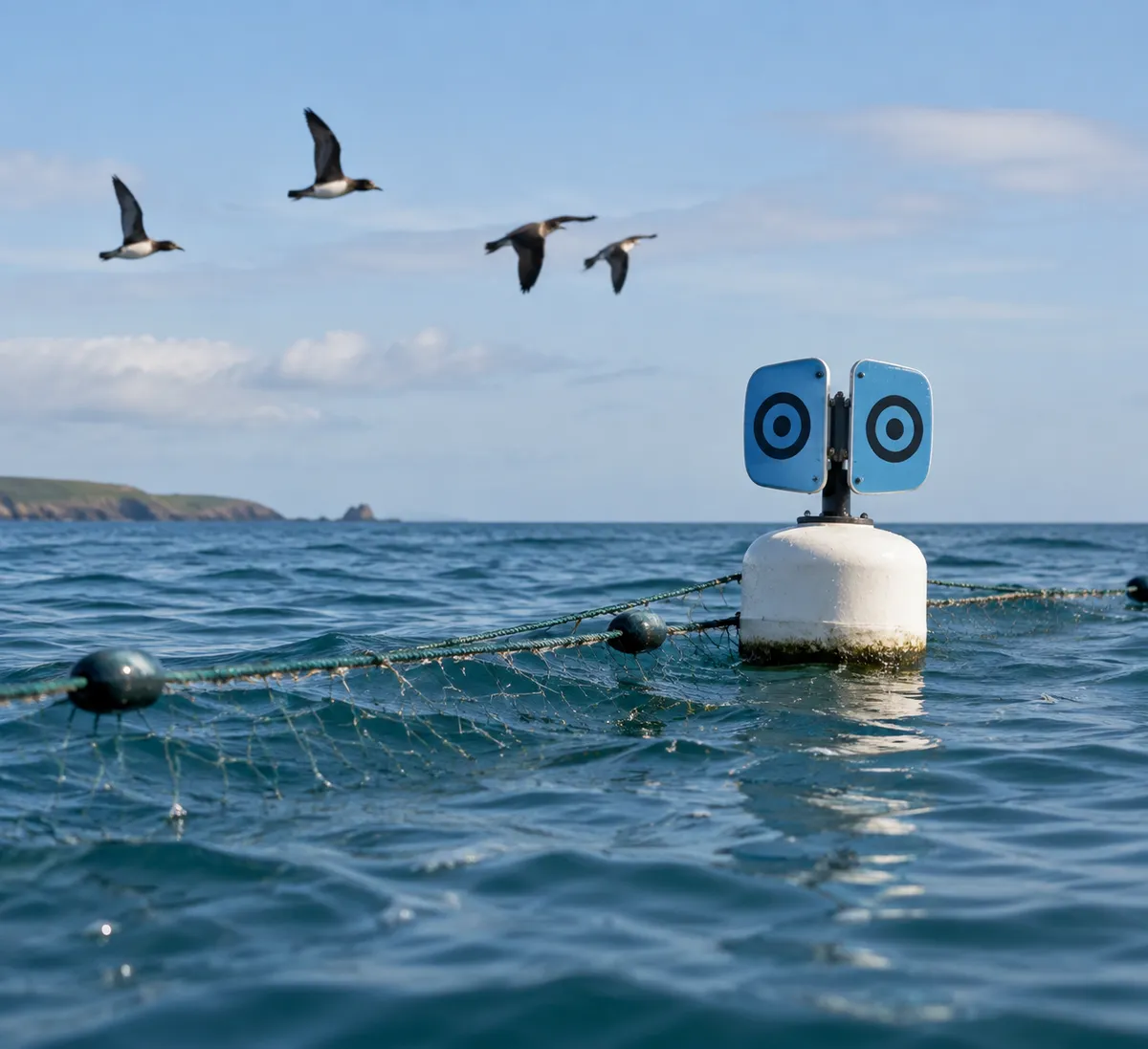
A buoy with a looming, animated eye may be one of the simplest tools yet for keeping seabirds out of fishing nets. In tests off Cornwall, U.K.-based scientists found that this "floating scarecrow" reduced seabird bycatch by around two-thirds when deployed strategically, per a report on Phys. Here's how it works, what it did and didn't show, and why it matters for both birds and fishing communities.
What the floating scarecrow actually is
The device is called a Looming Eye Buoy, or LEB. It floats on the water and uses an animated eye effect meant to look like something watching, and approaching, the birds. The idea is the same as a field scarecrow: make a risky spot feel unsafe so animals steer clear.
The researchers tested it off Cornwall alongside a second deterrent, a repurposed bird-scaring kite designed to look like a bird of prey. Both are aimed at the same problem: diving seabirds getting tangled in nets they can't see underwater.
The problem it targets
Gillnets are walls of fine netting that hang in the water. Diving seabirds such as guillemots and razorbills chase fish beneath the surface, hit the net, and drown. Per the report, an estimated 95,000 diving seabirds die this way each year in European gillnets.
That makes bycatch a serious conservation issue for threatened species, and one that can't be solved by simply telling fishers to stop. Gillnet fishing supports livelihoods and food supplies, so any fix has to work alongside it.
What the results show
When the LEB was deployed strategically, seabird bycatch fell by around two-thirds. The word "strategically" matters. The findings also point to seasonal and location-specific patterns in when and where birds get caught, which means protection works best when it is aimed at the highest-risk times and places rather than spread thin everywhere.
That is good news for practicality. A deterrent that only needs to be used at certain times or in certain areas is cheaper and easier for a fishing crew to adopt.
Why targeting beats blanket coverage
If bycatch clusters in particular seasons and spots, fishers can put their effort where it counts. Using the data this way has three clear advantages:
- Lower cost: Fewer devices are needed than a year-round, everywhere approach.
- Less hassle: Crews change their routine only when risk is highest.
- Better odds of adoption: Tools that fit into existing fishing practice are more likely to actually be used.
The research is presented as some of the strongest evidence yet that simple, low-cost deterrents can protect vulnerable seabird populations without disrupting fishing operations.
How it compares with other fixes
The two-thirds reduction is meaningful, but it isn't the highest figure out there. The report notes that success rates above 90% have been seen in African fisheries. I can't say from the report what methods or conditions produced those numbers, so treat the comparison as context rather than a head-to-head ranking. Results vary by species, gear, and location, and a tool that performs well in one place may not match that elsewhere.
Still, a two-thirds drop with a device this simple is a strong start, and there may be room to improve it.
Why fishers are part of the story
The work involved scientists and fishers collaborating on a real-world problem. That's not a side detail. A deterrent only saves birds if it's out on the water, and that depends on the people running the boats being willing to use it. Solutions that protect wildlife while keeping fishing viable are far likelier to stick than rules that treat the two as opposites.
What you can take from this
You don't need to be near a coastline for this to matter. A few points to carry with you:
- Bycatch is a hidden cost of seafood. Birds, not just fish, are affected by how a catch is made.
- Low-tech ideas can work. An animated eye and a kite shaped like a predator cut deaths substantially.
- Timing and place matter. Good data lets conservation effort go where it does the most good.
- Cooperation beats confrontation. Solutions built with fishers have a better chance of lasting.
If you want to support this kind of work, look for conservation groups and seafood programs that publish how they address bycatch, and ask questions about the gear used to catch what you buy. Pressure from informed buyers helps turn promising trials like this one into everyday practice.