Japan's population peaked around 2008 and has been falling ever since. Construction, though, hasn't stopped. By the end of this piece, you'll understand why that mismatch matters for the planet, and what a different approach, sometimes called "post-growth architecture," looks like in practice.
The details below come from an article reported by Phys on how Asia's architectural future must reckon with the limits of both people and planet.
The problem: more buildings, fewer people
Per Phys, Japan has more than 9 million vacant homes. At the same time, new building continues. That is the core tension: a development model built for growth, running in a society that is shrinking and aging.
The issue reaches beyond Japan. The article points to aging, shrinking communities across East Asia, and argues that growth-driven construction collides with planetary limits. New buildings need materials and energy. Building more when you already have empty space is hard to justify on those terms.
The pressure is also growing from other directions. Per the report, climate pressure, material scarcity, and housing instability are all intensifying. Architecture is being pushed to become more adaptive, more local, and lower in waste.
The shift: work with what already exists
The central idea is simple to state. Instead of asking "what should we build next?", ask "what do we already have, and how can it serve people now?"
The article describes architects in Japan, China, Taiwan, and Korea who are adapting to several realities at once:
- Demographic decline
- Resource limits
- Disasters
- Shrinking budgets
The answer, as the piece frames it, leans on reuse, repair, and community labor rather than endless new construction.
Reuse and repair beat demolition
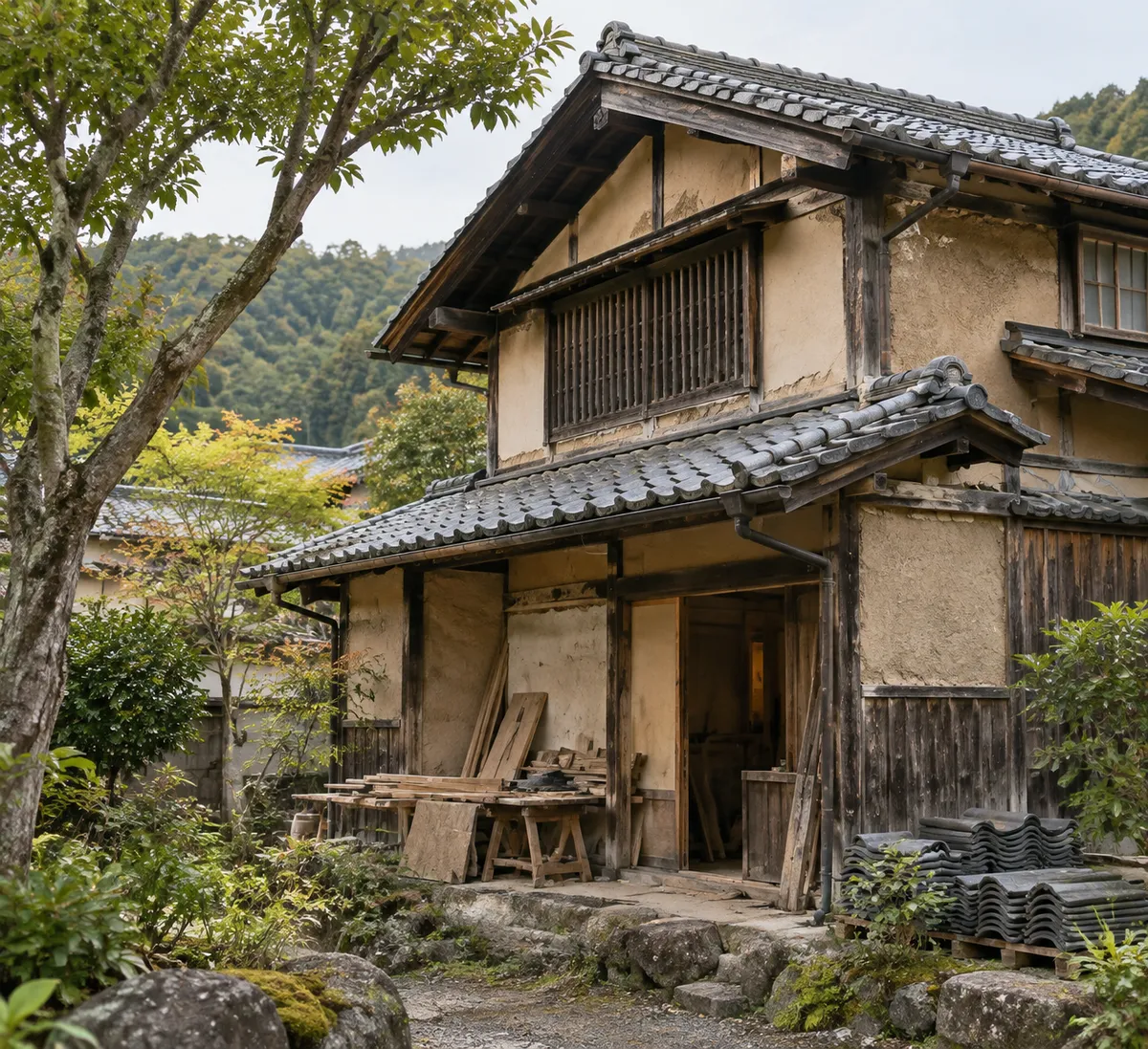
An empty house is a stock of materials, structure, and land already paid for in energy and resources. Reusing or repairing it avoids the cost of making all of that again. That is the logic behind the article's emphasis on working with existing buildings.
It also connects to design. The article highlights the beauty of using discarded materials. That is a useful reframe: salvaged material isn't a compromise you tolerate when money is tight. It can be a design choice with its own character.
Communities can build without big contractors
One of the article's themes is community labor. When budgets shrink and big contractors are out of reach, local people can take part in rebuilding themselves.
This matters most after disasters, which the article names as one of the forces shaping East Asian architecture. A community that can repair and build with its own hands, using locally available and reclaimed materials, is less dependent on supply chains and large budgets.
I can't tell you from the source how any individual project was organized, so treat this as the general principle the article describes rather than a how-to manual.
"Loose-fit" design: buildings that can change
The article also champions "loose-fit" design. The idea, as I read it, is a building that isn't tailored so tightly to one purpose that it becomes useless when circumstances shift. A loosely fitted structure can take on new uses as a community ages, shrinks, or faces new conditions.
That's relevant to climate adaptation too. Nobody knows exactly what a neighborhood will need in 30 years. Buildings that can flex are a safer bet than ones designed for a single fixed future.
What this means for you
You don't have to be an architect to apply the thinking. A few practical takeaways follow from the article's logic:
- Question new-build assumptions. If your area has empty buildings, ask whether they could meet the need before anything new goes up.
- Value repair. Fixing and adapting is a legitimate, low-waste route, not a lesser one.
- Look at local labor and materials. Community involvement and salvaged materials can cut costs and waste.
- Favor flexibility. When you have a say in a renovation or a development, prefer spaces that can change use.
The broader point is that shrinking doesn't have to mean decline. Japan's 9 million-plus empty homes are a problem, but they are also a resource, and the architects in this story are treating them that way.
The next time you see a new development going up, ask what's already standing nearby that could do the job.