If you live below a mountain forest, or just love hiking through one, here is what a new Swiss study means for you: the trees that quietly hold back avalanches, rockfalls, and floods are getting weaker, and the high-altitude stands once assumed to be safe are no longer exempt.
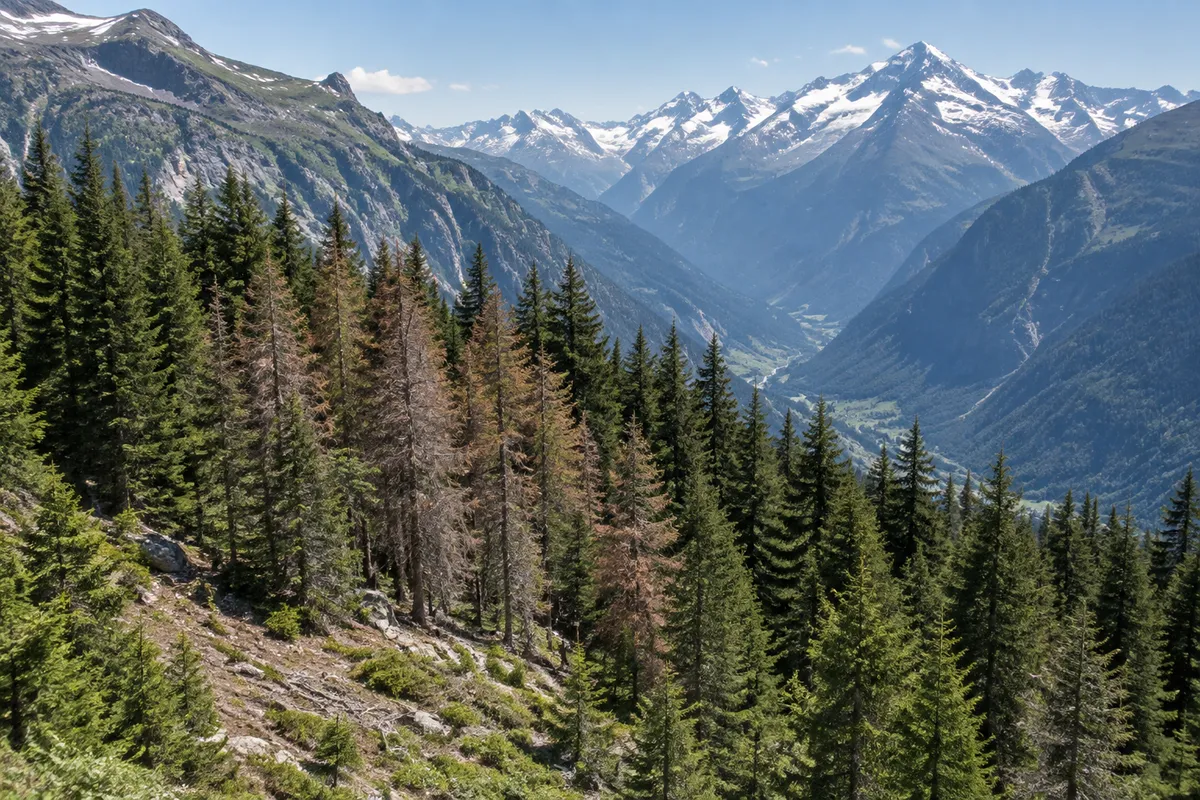
Per a report from Phys on the research, Swiss scientists found that forests in Switzerland have reached a tipping point. Summer droughts, driven by global warming, are now overwhelming the tolerance and resilience of trees. Even trees at 2,200 meters are showing stress.
The altitude assumption that just broke
For a long time, the logic seemed sound. Drought was a problem for low, warm forests. Higher up, it is cooler, so trees there were thought to be resilient to dry spells.
That assumption no longer holds. According to the report, summer droughts are killing large trees across all elevation zones, not just the lower ones. Height above sea level, it turns out, is not the protection it once seemed to be.
The practical lesson: when you hear that a forest is "high enough to be fine," treat it as an old rule of thumb, not a guarantee.
Why weak trees mean more danger in the valley
Mountain forests are working infrastructure. The Phys report notes that they protect valleys from avalanches, rockfalls, and floods. Trees anchor slopes, and a healthy stand makes it harder for hazards to build momentum.
When large trees die, that protection thins. The study, as reported, points to a compounding problem for mountain communities: the natural barriers they depend on are deteriorating just as climate change shifts precipitation patterns and raises temperatures.
This is easy to miss because it is slow. A bridge failing makes headlines. A forest gradually losing its biggest trees does not, yet the consequence can be the same kind of failure, with the same people at risk.
What the pattern tells you
The researchers tied the decline to summer drought rather than to a single storm, pest, or event. That matters because droughts are recurring. A forest that gets hit repeatedly has less chance to recover between episodes. The Phys description frames this as drought overwhelming trees' tolerance, which is the language of a system pushed past its limit rather than one having a bad year.
Our read: the word "tipping point" is the key. It suggests the question is shifting from "will forests cope?" to "how do we manage forests that no longer cope on their own?"
What this means for Alpine regions beyond Switzerland
The findings come from Switzerland, and the source material does not detail results for other countries, so it would be a stretch to say exactly how other ranges are faring. But the implications are described as relevant to Alpine regions across Europe, because the underlying drivers, rising temperatures and shifting precipitation, are not confined by borders.
If you live in or visit a mountain region, a sensible takeaway is to pay attention to how local authorities assess their protective forests, not only the forests' appearance.
What you can do with this information
You cannot replant a slope yourself, but you can act on what the study shows:
- Check local hazard information. If you live below a steep forested slope, find out whether your area maintains hazard maps and how they account for forest condition.
- Respect closures and warnings. Trail and road restrictions in mountain areas exist for reasons that may be changing as forests weaken.
- Support adaptive forestry. The study's authors and coverage point toward a need for adaptive forest management in the near term. Ask local officials what their plans are.
- Update your mental model. Do not assume that elevation means safety, for forests or for the places they protect.
The takeaway
The old comfort that high forests were beyond drought's reach is gone. If mountains are part of your life, ask your local forestry or hazard authority how the protective forest above you is doing, and what is being done to strengthen it.