
By the end of this article, you'll understand one of the ocean's quietest climate tricks: how cells too small to see can help carry carbon from sunlit surface water down toward the deep, and why scientists want to know which ones do it best.
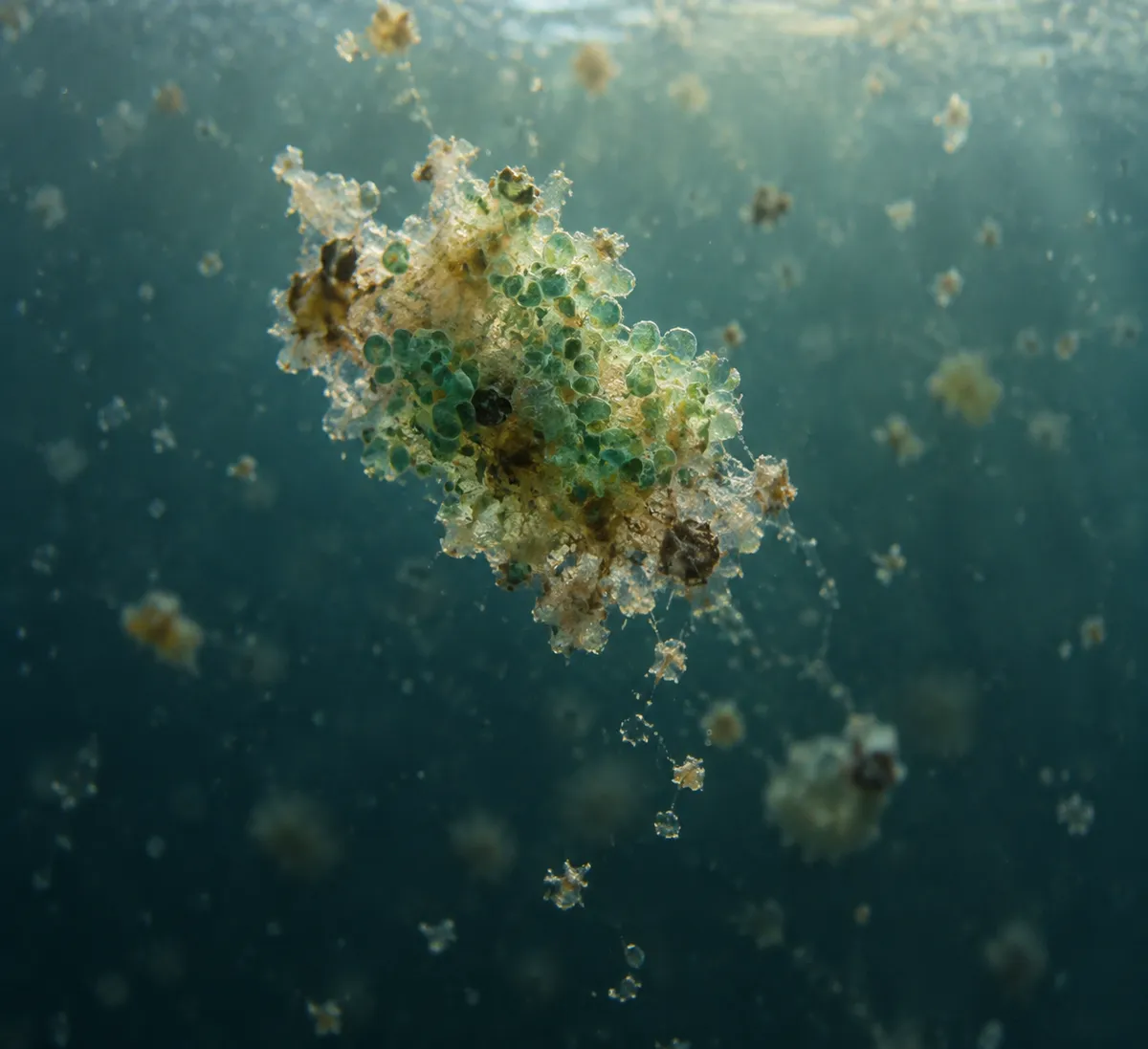
A new study from Stockholm University's Department of Ecology, Environment and Plant Sciences, as reported by Phys, finds that tiny photosynthetic organisms in the Baltic Sea can contribute substantially to moving carbon from surface waters into deeper layers. The trick is teamwork: the cells form colonies and aggregates that sink.
The Problem With Being Tiny
The organisms in question are picocyanobacteria, a type of picophytoplankton. They photosynthesize, pulling in carbon dioxide and turning it into living material, just as plants do.
Being very small is normally a handicap for sinking. A single microscopic cell has little weight to pull it down, so you'd expect it to drift near the surface and be recycled there. Per the report, the study shows these cells can overcome their size by clustering into colonies and aggregates, which sink and take their carbon with them.
What the "Biological Pump" Means
Think of the biological pump as the ocean's conveyor belt for carbon:
- Photosynthetic organisms in sunlit surface water take up carbon.
- That carbon becomes part of their bodies.
- When those bodies clump and sink, the carbon is transported to deeper layers, away from the surface.
The Baltic Sea work gives a concrete example of step three happening with some of the smallest players, which you might not expect to matter much.
Not All Strains Behave the Same
The most useful finding is that different strains aggregate differently. According to the research summary, this trait is a key factor in how much carbon gets exported.
In practical terms: two groups of equally tiny cells can have very different effects on carbon storage, depending on how readily they stick together and sink. Counting how many cells are in the water isn't enough. Which strains they are matters too.
Why Warming Oceans Raise the Stakes
Per the report, as oceans warm, stratify and become more nutrient-poor, picophytoplankton are expected to become more abundant. If that happens, how they behave could reshape how the ocean stores carbon.
This is why the finding matters beyond the Baltic. Climate models try to predict how much carbon the ocean will hold and, in turn, future atmospheric CO2 levels. If models treat tiny cells as unimportant for sinking carbon, they may miss a real pathway. Adding strain-level differences in aggregation could make those predictions more accurate. That's my reading of the implication; the study itself doesn't give a number for how much predictions would change.
What You Can Take From This
- Size doesn't set impact. Microscopic organisms can matter for carbon transport when they cluster.
- Details inside a group matter. Strain-level differences in aggregation change how much carbon sinks.
- The ocean's carbon storage is not fixed. As conditions shift toward warmer, more stratified, nutrient-poor water, the mix of organisms, and therefore the carbon pump, may shift too.
The next time you read a headline about ocean carbon, remember the small print: some of the biggest climate work may be done by cells that only count when they stick together. Keep an eye out for research that tracks which organisms are doing the sinking, not just how much life is at the surface.